
Operation & Maintenance
Most CNC machine installation problems are decided before the machine arrives, not on the day it lands. The accuracy a lathe will hold for the next decade is set by four things: whether the site was prepared to the foundation drawing, whether the machine was levelled and anchored properly, whether the services were verified before the first start, and whether geometry and performance were measured against acceptance criteria agreed in the order. This checklist works through those four in the order the work actually happens.
Why CNC machine installation fails on the site, not the machine
A machine tool is the most accurate thing most workshops will ever bolt to the floor, and the floor decides whether that accuracy survives transport. The machine leaves the factory aligned and tested, then arrives as precision geometry that has been lifted, tilted and driven over roads.
Installation problems are rarely dramatic, which is why they are accepted: a machine slightly out of level cuts acceptable parts for a while, then drifts as the bed warms up. That is not a machine fault and it is not covered by a warranty claim. The discipline that governs choosing the machine, set out in how to choose a CNC lathe, governs putting it into service.
Site readiness before the machine arrives
Everything in this phase is a drawing and a measurement, and all of it has to be finished before the machine is on the road. The foundation drawing supplied with the machine defines the concrete dimensions, the anchor pocket positions and the depth — none of which can be adjusted later with a spanner.
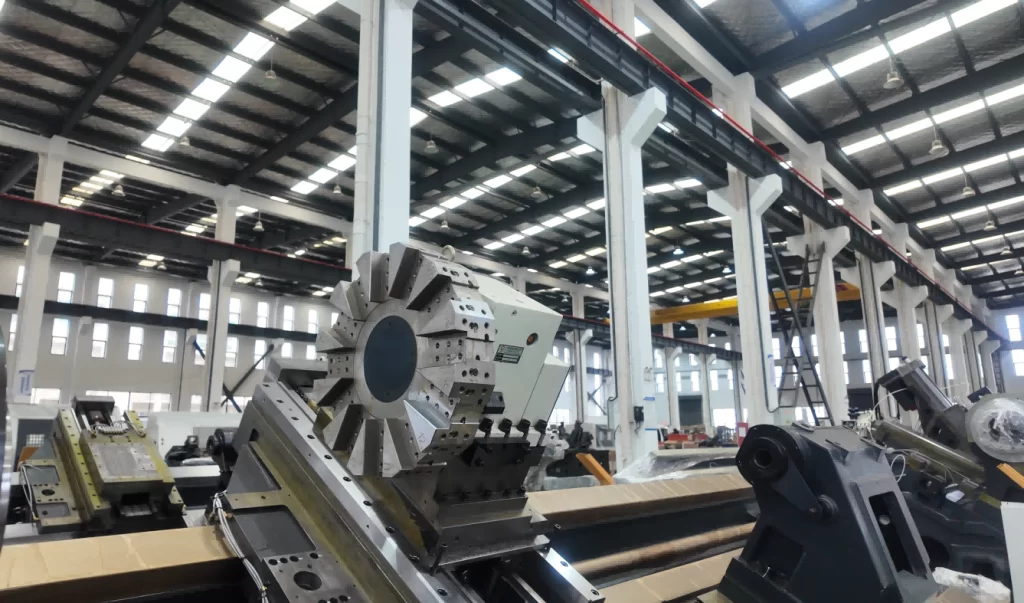
Mass and bed length set the floor loading and the access question. A lathe that cannot pass through the workshop door cannot be solved on delivery day, so the route is measured in advance. The DAHUI MT CNC lathe range gives the dimensions and mass of each model, which is where that measurement starts.
| Foundation and floor loading | Built to the machine foundation drawing, sized for the machine mass and bed length, with anchor pockets in the marked positions |
|---|---|
| Access route | Gate, door opening, corridor width and turning space measured against the largest packaged section, not the bare machine |
| Lifting equipment | Crane, forklift or skates arranged for the delivery date, with slings and shackles rated for the load |
| Electrical supply | Voltage, phase and frequency available at the machine position, with supply capacity and earthing arrangement confirmed |
| Compressed air | Pressure as specified, and dry, oil-free air — water carried in the line ends up in the pneumatic valves |
| Coolant and chips | A decided location for coolant mixing and storage, and clearance where the chip bin or conveyor discharges |
| Environment | Ambient temperature range, draughts from doors, and direct sunlight on the machine bed |
| Services routing | Cable tray, air line and coolant pipe routes fixed before the machine occupies the floor space |
Receipt, lifting and positioning
The machine is at its most vulnerable in the first hours after delivery, while it is still packed and nobody has confirmed the condition it left the factory in. Photograph the packing before anything is opened: transit damage has to be recorded before the delivery note is signed.
Lifting is where insurance claims begin. The slings and shackles must be rated for the mass and used by someone competent to judge the rigging. In markets that follow the UK framework, that duty is set out in the Lifting Operations and Lifting Equipment Regulations guidance from the Health and Safety Executive, and the principle holds anywhere: a lifting plan made in advance, by someone who knows the load.
- Compare the packing list against the machine and every accessory, line by line
- Confirm the marked lifting points and the rating of every sling and shackle
- Move the machine into position on rollers or skates, shipping braces still fitted
Setting, levelling and anchoring
Levelling is a sequence, not a single act: roughly level first, so the machine is not resting on two opposite corners, then aligned to the tolerance stated in the machine alignment specification, working across the pads in a checkerboard order and re-checking the seats already adjusted. Only when the alignment is holding are the anchor bolts tightened and the grout poured. Tightening anchors on a machine that is still moving pulls the bed out of level and buries the error under the grout.
Do not skip the second measurement
Alignment taken once is an assumption rather than a record. Measure it at the end of the setting work, again after the grout has cured, and once more after the warm-up routine: three readings at the same points are what make the baseline trustworthy.
Setting a used machine
A used machine arrives without the factory alignment record, so the readings taken on arrival become the only baseline you will have. Note the condition of the anchor points before anything is adjusted. The cost lines that separate the two purchases are set out in the new versus used total cost of ownership comparison, and they apply to the installation as much as to the decision.
Need to know what the machine should hold on arrival? See how DAHUI MT machines are built and tested →
Services connection and pre-start checks
The electrical connection is where a CNC machine installation is most often under-specified. The supply has to match the machine nameplate for voltage, phase and frequency, with capacity left for the spindle accelerating under load rather than only for the machine idling. The protective earth and the isolation device have to be in place before anything is energised, and the phase sequence has to be checked on a three-phase supply. The connection should be made by someone competent to do it — the expectation of competence and isolation that the electricity at work guidance from the Health and Safety Executive sets out for industrial installations.
Air and fluids follow: dry, clean compressed air, and oil, hydraulic and coolant grades taken from the machine manual rather than from the shelf.
The most commonly missed step
A transit brace left in place is invisible until the first rapid traverse, and by then it has usually broken something. Work through the shipping-brace list in the manual, marking each item off at the machine rather than from memory.
Commissioning: geometry, function and performance
Commissioning is the part of a CNC machine installation that turns a machine which runs into a machine which is verified. Return the axes to reference from a cold start, confirm that limits and interlocks behave as described, then measure the geometry with the spindle warm. The acceptance criteria belong in the order — tolerance, surface finish and the operation being demonstrated — because a criterion invented during commissioning always ends up matching whatever the machine happens to produce.
| # | What to verify | What it proves | How it is checked |
|---|---|---|---|
| 1 | Reference return | The control and the mechanics agree on where the machine is | Return to reference from a cold start and compare the displayed position with a dial indicator |
| 2 | Axis straightness | The saddle or column does not ride off line along the bed | Indicator swept along the reference surface over the full travel |
| 3 | Squareness | The axes are perpendicular, so a turned or faced surface comes out flat | Indicator mounted to one axis and swept against a reference on the other |
| 4 | Spindle run-out | The workholding will not put the same error into every part | Indicator on the spindle nose and inside the taper, with the spindle warm |
| 5 | Backlash | The axis lands in the same place whichever way it is approached | Approach the same point from both directions and compare the readings |
| 6 | Repeatability | The machine returns to the same position again and again | Repeated approach to one point, with every result written down |
| 7 | Thermal behaviour | Accuracy holds as the machine reaches working temperature | Measure the test part, run the warm-up routine, measure again |
| 8 | Test cut | Everything above holds under cutting load, not only at idle | Cut the agreed part and measure it against the acceptance criteria |
Acceptance, documents and handover
At the end of a CNC machine installation the paperwork is the deliverable. An acceptance protocol signed with measured values answers the question “was this machine accurate when it was new?” three years later, when nobody remembers the installation. Collect the alignment record, the test report and a backup of the control parameters while the commissioning engineer is still on site: after that engineer has left, a parameter file becomes a support request.
Add the wiring, hydraulic and pneumatic diagrams, the maintenance manual with its lubrication chart, and a spares list with part numbers, so that the first unplanned stop is a part order rather than an investigation. Confirm that the declaration of conformity and the machine technical file are in your hands, because that is what allows the machine to be placed in service in your market. Where the machine has come from overseas, the document set is the one listed in the due diligence checklist for buying a CNC machine from China.
The printable commissioning checklist
The phases above explain what has to happen and why. This is the CNC machine installation checklist in a form you can print and work through at the machine.
Before the machine is energised
- Supply voltage, phase and frequency confirmed against the nameplate
- Protective earth, isolation device and phase sequence verified
- Every transit lock and shipping brace removed and marked off the list
- Lubricant, hydraulic oil and coolant levels and grades checked against the manual
- Cabinet opened, inspected for condensation and loose terminals, then closed
- Spindle rotated by hand through a full turn
After the first power-on
- Reference return completed in the sequence given in the manual
- Soft limits, travel limits and emergency stop confirmed to stop the axis
- Door interlocks and guard switches confirmed to inhibit the cycle
- Turret or tool changer indexed through every station without an alarm
Geometry and performance
- Bed alignment measured and recorded after the grout has cured
- Spindle run-out measured at the nose and in the taper, spindle warm
- Axis straightness and squareness measured over the full travel
- Backlash and repeatability measured from both approach directions
- Agreed test part cut, measured and recorded against the criteria
At handover
- Acceptance protocol signed with measured values rather than a tick
- Alignment record, test report and control parameter backup received
- Wiring, hydraulic and pneumatic diagrams received
- Maintenance manual, lubrication chart and spares list received
- Declaration of conformity and technical file received
What goes wrong, and how to avoid it
The same failures appear on almost every CNC machine installation that goes badly.
Do this
- Measure the access route and the foundation before dispatch
- Photograph the packing before unpacking anything
- Level, anchor, then re-measure after curing and after the warm-up
- Verify supply, earth and phase sequence before the first start
Avoid this
- Starting the machine with a transit brace still fitted
- Deciding alignment tolerances during commissioning instead of in the order
- Feeding welding equipment from the same supply circuit
- Running the machine on a wet compressed air line
Frequently asked questions
How long does a CNC machine installation and commissioning take?
The mechanical work — positioning, levelling, anchoring and the verification measurements — is usually measured in days. What sets the front of the schedule is the foundation and its curing, and no amount of planning compresses that. Plan backwards from the civil work, agree who provides the crane and the power connection, and only then fix the delivery date.
Does a CNC lathe need its own foundation?
That is set by the machine rather than by the workshop. A heavy lathe with a cast bed needs a separate foundation with anchor pockets in the positions shown on the foundation drawing, because the rigidity of the bed is only useful if what it stands on is equally rigid. Smaller machines may sit on a suitably stiff floor slab, but the decision should come from the drawing, not from an opinion about the floor.
Who is responsible for levelling and commissioning?
It is a commercial decision, and it belongs in the order rather than in a conversation on installation day. Civil work, grout, lifting, power connection and compressed air are normally the buyer’s scope; alignment, geometry verification, the test cut and operator training are normally the supplier’s, and each line should name a party and a deliverable.
What has to be checked before the first power-on?
The supply matches the nameplate, the earth and isolation device are in place, and the phase sequence has been checked. Every transit lock and shipping brace is off the machine. Oil, hydraulic and coolant levels use the grades specified in the manual, the cabinet is dry, and the spindle turns freely by hand. Only then is the machine energised.
What documents should I receive at handover?
The acceptance protocol with measured values, the alignment record, the test report for the acceptance part, and a backup of the control parameters. Add the wiring, hydraulic and pneumatic diagrams, the maintenance manual with its lubrication chart, a spares list with part numbers, and the declaration of conformity with the technical file for your market.
Next step
Tell us the part you need to make and where the machine will stand. Send the workpiece drawing, the material, the tolerance you must hold and your annual volume, together with the floor and services you have available. Our engineering team will come back with the configuration that does the job in one setup, the foundation it needs and what the commissioning involves — so the installation is planned before the machine is ordered.
Send your part drawing to our engineering team
WhatsApp: +86 15502628547 · Email: info@dhlathe.com
