
Machine Comparison
A box way and a linear guideway do the same job by opposite means, and the difference shows up in two places: how the machine behaves under a heavy, interrupted cut, and how it behaves when it has to move fast and stop precisely. A box way is a large cast-iron sliding surface with a low-friction lining, scraped to fit; it damps vibration well and carries shock loads, at the cost of friction, heat and speed. A linear guideway is a hardened rail with recirculating rolling blocks; it is fast, almost friction-free and free of stick-slip, at the cost of damping and tolerance for contamination. The right answer follows from the cut you take most often, not from the price list.
The box way vs linear guideway difference in one table
Both designs locate the slide on the bed; what changes is how the load travels from the tool into the casting.
| Behaviour | Box way (sliding) | Linear guideway (rolling) |
|---|---|---|
| Load path | Large area of cast iron on cast iron, with a Turcite or bronze lining on the moving member | Hardened rail and recirculating ball or roller blocks, preloaded against the rail |
| Friction | Higher, and it changes with lubrication and speed | Very low, and nearly constant |
| Stick-slip at low feed | Possible if lubrication is poor | Effectively absent |
| Damping | High — the joint absorbs vibration | Low — vibration passes into the structure |
| Shock and interrupted cuts | Well suited | Needs a roller type and generous preload to match |
| Speed and acceleration | Limited by friction and heat | High rapids and high acceleration |
| Accuracy retention | Gradual wear, correctable by re-scraping | Holds until the block or rail is damaged, then replaced |
| Contamination | Tolerant of chips and coolant to a point | Sensitive — wipers and covers are part of the design |
| Repair | Re-scrape or re-line, in situ or at a rebuilder | Replace rail or block; the mounting surfaces must be re-checked |
| Lubrication demand | Continuous, and a failure shows up as wear quickly | Lower volume, but a dry block fails fast |
Read the table as a set of trades rather than a ranking. Neither column is better; each is better at a particular kind of work, and a machine that is excellent for one shop is mediocre for another.
What a box way gives you
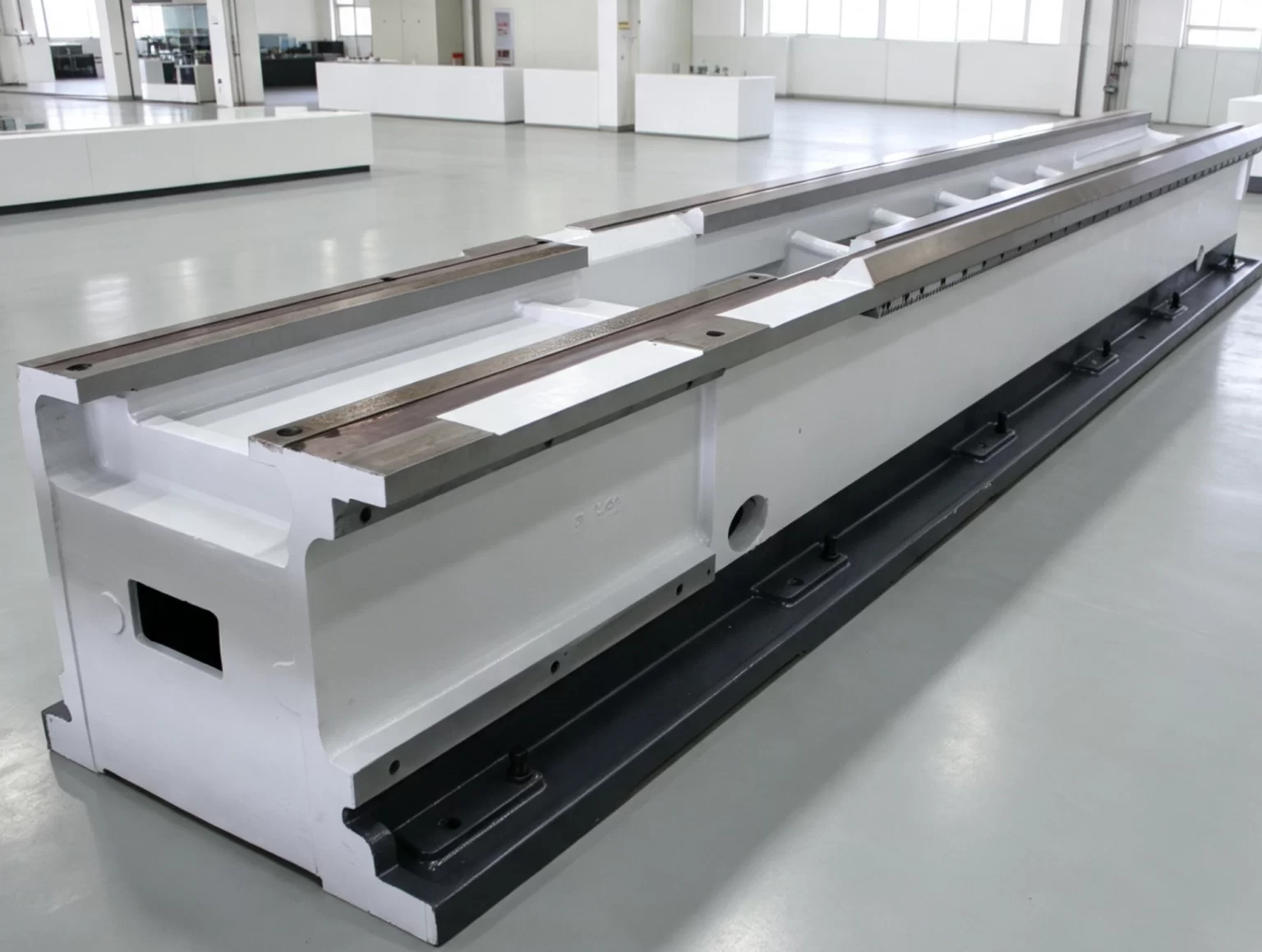
The strength of a box way is the joint itself. Two large cast surfaces held together by gravity, wedge adjustment and oil film make a connection that absorbs energy, and that is exactly what an interrupted cut needs. When a tool enters a casting skin or crosses a keyway, the shock has to go somewhere; a sliding joint spreads it over a large area and damps the ring that would otherwise show up as chatter on the finished surface.
That is why heavy roughing, cast and forged blanks, and large-diameter boring are still box-way territory. The same joint also carries load well: the contact area is measured in square centimetres, not in the line contact of a rolling element, so a box way tolerates a heavy, off-centre or shock load without Brinelling anything. And when it does wear, the wear is gradual and visible, and a reconditioning shop can scrape it back to geometry rather than replace it.
The costs are familiar. Friction is higher, so rapids are slower and the axis generates heat as it moves. At very low feed rates the slide can move in small jumps rather than continuously — stick-slip — which shows up as a mark on the surface or as a hesitation in a delicate cut. And the design depends on lubrication reaching the full length of the slide; a blocked metering unit does not stop the machine, it quietly wears a step into the way.
What a linear guideway gives you
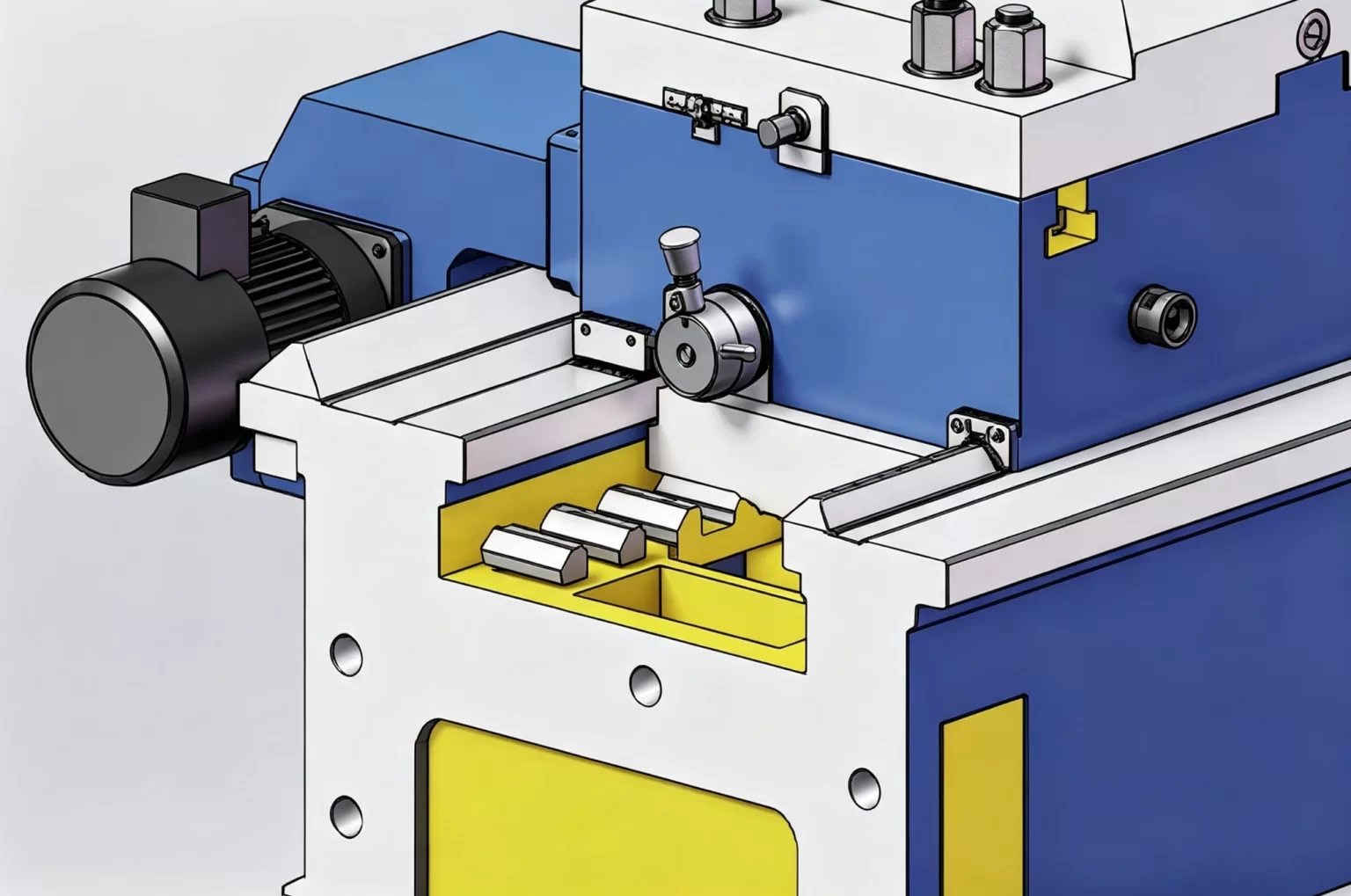
A linear guideway replaces the sliding joint with rolling contact. Friction drops by an order of magnitude and becomes almost independent of speed, which is why the same servo can accelerate harder, rapid faster and settle more repeatably. Stick-slip disappears, so a finish pass at a very low feed can be controlled in increments that a sliding way cannot resolve.
Preload is the second advantage. A block can be preloaded against the rail so that clearance is removed in every direction, which makes the axis stiff in the lateral and moment directions as well as vertically. On a lathe this matters when the turret is working far from the bed, or when a boring bar is reaching into a deep bore.
The trade is damping and contamination tolerance. Rolling contact transmits vibration rather than absorbing it, so the structure around the guideway has to be stiff enough to compensate — a linear-guide machine with a light casting rings. And a rail is a precision surface with a wiper at each end of each block: a damaged wiper, a chip trapped under a block or a coolant that carries fines into the raceway will damage the rail, and a damaged rail is replaced rather than re-scraped.
The question that separates them
Ask which single operation the machine must never fail at. If it is a heavy interrupted roughing cut, the damping of a box way is worth more than the speed of a linear guide. If it is a high-speed finishing pass on a thin wall, the predictability of a linear guide is worth more than the damping.
Deciding from the work, not the brochure
The box way vs linear guideway question is settled by describing the worst cut and the most common cut separately, then check that the chosen design serves both.
Choose a box way when
- The first operation removes a casting or forging skin, or the cut is interrupted by slots, keyways or ports
- Material removal is high and the machine runs at low spindle speeds with high torque
- Large or off-centre workpieces put a heavy, changing moment on the slide
- The shop values repairability over rapid speed, and has the discipline to keep way lubrication working
Choose a linear guideway when
- Cycle time is set by rapid moves and acceleration rather than by cutting time
- Finishing dominates: small tools, light cuts, tight tolerance, and a need to control very low feed rates
- The machine runs aluminium or non-ferrous work at high spindle speed with modest cutting force
- Contamination can be controlled — enclosed ways, covers, chip management and a coolant system that does not carry fines
Many production shops need both behaviours, and that is why the two designs coexist in one building rather than one replacing the other. A roller-type linear guideway with generous preload is the usual compromise: it recovers much of the stiffness of a box way while keeping most of the speed, and it gives up some damping in exchange.
How each one wears, and what to watch
Both designs fail predictably, and on either side of the box way vs linear guideway choice the early signs are different.
| Signal | Box way | Linear guideway |
|---|---|---|
| First sign | Way oil consumption rises, or the slide feels tighter at one end of the travel | Wiper shows metal fines, or the axis sounds different at one position |
| Effect on the part | Taper or a step that changes along the bed; finish varies with position | Localised mark, or a repeatable deviation at one point in the travel |
| Root cause | Lubrication starvation, contamination under the way, or a worn lining | Damaged wiper, chip ingress, coolant fines, or a rail that has been hit |
| Repair | Re-scrape or re-line; geometry re-established on the machine | Replace the affected block or rail; re-check mounting surface and alignment |
The maintenance routine that protects either design is the same in principle: keep the lubricant flowing, keep the wipers and covers intact, and read the consumption figures rather than waiting for a symptom. The CNC lathe maintenance checklist covers the checks that catch both failure modes early; if the slide is already showing lost motion, the diagnosis order in ball screw failure and replacement separates screw wear from guideway wear before anyone orders a part.
How to write it into the enquiry
An enquiry that only says “linear guide” leaves the important half unspecified, because two machines with the same rail size can behave very differently.
| Guideway type and size | Sliding way with lining type, or the rail width and block type — ball or roller — with the number of blocks per rail |
|---|---|
| Preload and accuracy class | The preload class and the accuracy grade of the rail, stated explicitly rather than left to the builder |
| Lubrication | Way-oil metering for a sliding way, or grease and oil intervals for a rolling one, with the automatic system included or not |
| Protection | Wiper type, telescopic covers or bellows, and how the design keeps chips and coolant off the way |
| Duty | The heaviest cut and the highest rapid the machine will see, so the design is checked against the real duty rather than a nominal one |
Then ask the builder to state which operation the design was chosen for. A supplier who can answer that has made an engineering decision; one who answers with a rail brand has made a purchasing decision.
Box way vs linear guideway: three shop profiles
Reading the table is one thing; recognising your own shop in it is another. Three profiles cover most of the machines sold into general engineering, and the box way vs linear guideway decision usually follows the work rather than the specification.
The jobbing shop with mixed work. One week a casting skin, the next a batch of aluminium housings. Here the decision is about the worst case, and the usual answer is a box way on a machine heavy enough that the finishing passes stay stable, or a roller linear guide with generous preload if rapid time matters. What such a shop should not do is buy a light linear-guide machine for the roughing week and hope the finish survives.
The production cell running bar work. Short cycles, high spindle speeds, aluminium or free-cutting steel, and a bar feeder at the back. Chip volume is high and continuous, and the machine spends more time accelerating than cutting. A linear guideway earns its place here, provided the way protection is designed rather than added: wipers, covers and a coolant system that does not circulate fines.
The heavy-machining shop. Large diameters, interrupted cuts, low spindle speeds and a high material removal rate. A box way is the conservative answer, and a box way vs linear guideway argument that ignores the shock loading in this profile will end with a damaged rail and a machine that has to be taken apart. If a linear guide is chosen anyway, the roller type and the preload matter more than the rail brand.
Frequently asked questions
Is a linear guideway always more accurate than a box way?
Comparing a box way vs linear guideway on paper answers this badly, because paper has no contamination. No. A new linear guide can position more repeatably because friction is low and predictable, but accuracy over years depends on the structure and on protection. A well-kept box way in a heavy casting can hold tolerance longer than a linear guide whose wipers have been letting fines through.
Can a box-way machine run fast?
It can run faster than many operators expect, but the limit is heat and friction in the slide rather than the servo. The practical ceiling shows up as way-oil temperature and as wear at the ends of the travel, where the slide spends least time.
Which is more expensive to own?
It depends on which failure you get. A box way consumes more lubricant and needs re-scraping eventually; a linear guide needs wipers and protection, and a damaged rail is a replacement rather than a repair. Both are cheap to own when the lubrication and the protection work, and expensive when they do not.
Does the guideway choice affect the machine’s footprint?
Yes, indirectly. A box way needs a wider, heavier bed to carry the same load, and a sliding way needs room for the way covers and the lubrication lines. A linear guide packages into a smaller section for the same load, which is one reason high-speed machines tend to use it.
What if the machine will do both roughing and finishing?
Then state both duties in the enquiry and ask which design the builder proposes for the roughing cut, not for the brochure. A roller-type linear guideway with higher preload, or a box way on the heavier axis, are both legitimate answers — as long as the reason is the cut rather than the price.
Tell us the cut, and we will tell you the guideway
Send the workpiece material, the heaviest depth of cut, the tolerance you must hold and the cycle time you need. We will come back with the guideway type and preload class that suits that duty, and show you which CNC lathe series carries it.
Send your cutting dataSee the lathe range
WhatsApp +86 15502628547 · info@dhlathe.com
Include the material, the blank form and the tolerance. Those three decide more about the guideway than the machine size does.
