
Machine Comparison
The slant bed vs flat bed lathe decision is settled by three things that have nothing to do with the control: where the chips go, where the heat goes, and how the workpiece is loaded. A slanted bed puts the cross slide on an incline, so gravity carries chips away from the cut, the structure is more symmetrical thermally, and a bar feeder or a robot can reach the spindle without fighting the machine. A flat bed keeps the cross slide horizontal, which gives more room and stability for large, heavy or long workpieces, easier manual access, and a lower cost at large swing diameters. Neither is the modern choice; each is the right choice for a different mix of parts.
What actually changes with the angle
Both machines turn a workpiece on a horizontal spindle axis. The difference is the plane the cross slide travels in. On a flat bed, the saddle runs along the bed and the cross slide moves horizontally across it, so the tool approaches the workpiece from the side. On a slant bed, the whole carriage is rotated — commonly thirty, forty-five or sixty degrees — so the cross slide moves down and toward the workpiece on an incline.
That single change cascades. The tool post sits below and in front of the centre line rather than beside it, chips fall away from the cutting zone instead of onto the ways, and the machine’s mass is arranged around the spindle rather than behind it. It also changes what is easy to build: a slant bed machine is usually shorter front to back for the same swing, which matters when a shop is laying out a cell rather than a single machine.
| Characteristic | Slant bed | Flat bed |
|---|---|---|
| Cross slide motion | Inclined, tool approaches from below the centre line | Horizontal, tool approaches from the side |
| Chip path | Falls away from the cut by gravity | Collects on the bed and around the saddle |
| Thermal symmetry | Better: mass is arranged around the spindle axis | Bed acts as a large, asymmetric heat sink |
| Footprint | Shorter front to back for the same swing | Deeper, and wider as swing grows |
| Manual access | Restricted by the enclosure and the angle | Open and direct, easier for large or awkward parts |
| Large-diameter work | Practical up to a point, then the bed gets very tall | Natural for large discs, rings and heavy blanks |
| Long shafts | Possible, but steady rests are harder to arrange | Well suited, with multiple steady rests along the bed |
| Automation | Bar feeders, gantry loaders and robots integrate cleanly | Possible, but the layout usually needs more engineering |
Chip and coolant behaviour
Chips are the most underrated variable in turning. A chip that stays in the cutting zone is re-cut, which raises temperature, spoils the finish and loads the insert; a chip that piles on the ways becomes a wear mechanism. On a flat bed the chip has to be pushed off the working area by coolant and gravity, and it lands on surfaces that the saddle then travels over. On a slant bed the chip leaves the cut and falls into the conveyor or the chip bin without touching a sliding surface.
Coolant follows the same path. On a slant bed the coolant drains away from the work zone toward the tank, which keeps the cutting area clear and makes high-pressure coolant more effective because the flow is not fighting a pool around the part. On a flat bed, coolant tends to collect around the saddle, and the machine depends on trays, seals and a well-designed return to keep it out of the way.
This is why high-volume production of small and medium parts migrated to slant beds: not because the angle is more accurate in itself, but because a machine that clears its own chips can run unattended for longer.
Thermal behaviour and accuracy over a shift
Every machine grows as it warms. What matters is whether it grows symmetrically. A slant bed arranges the headstock, the turret and the bed around the spindle axis, so the heat from the spindle, the ballscrews and the cutting process tends to move the structure in a way that is closer to uniform. A flat bed has a large horizontal casting that absorbs heat unevenly — warmer near the headstock, cooler at the tail end — and the resulting bend shows up as a taper that changes over the first hours of a shift.
This does not make a flat bed inaccurate. It means the warm-up routine and the compensation matter more, and that a shop running a flat-bed machine for precision work should establish a warm-up program and check the first article after it, not before. The same discipline applies to a slant bed, but the drift it has to absorb is smaller.
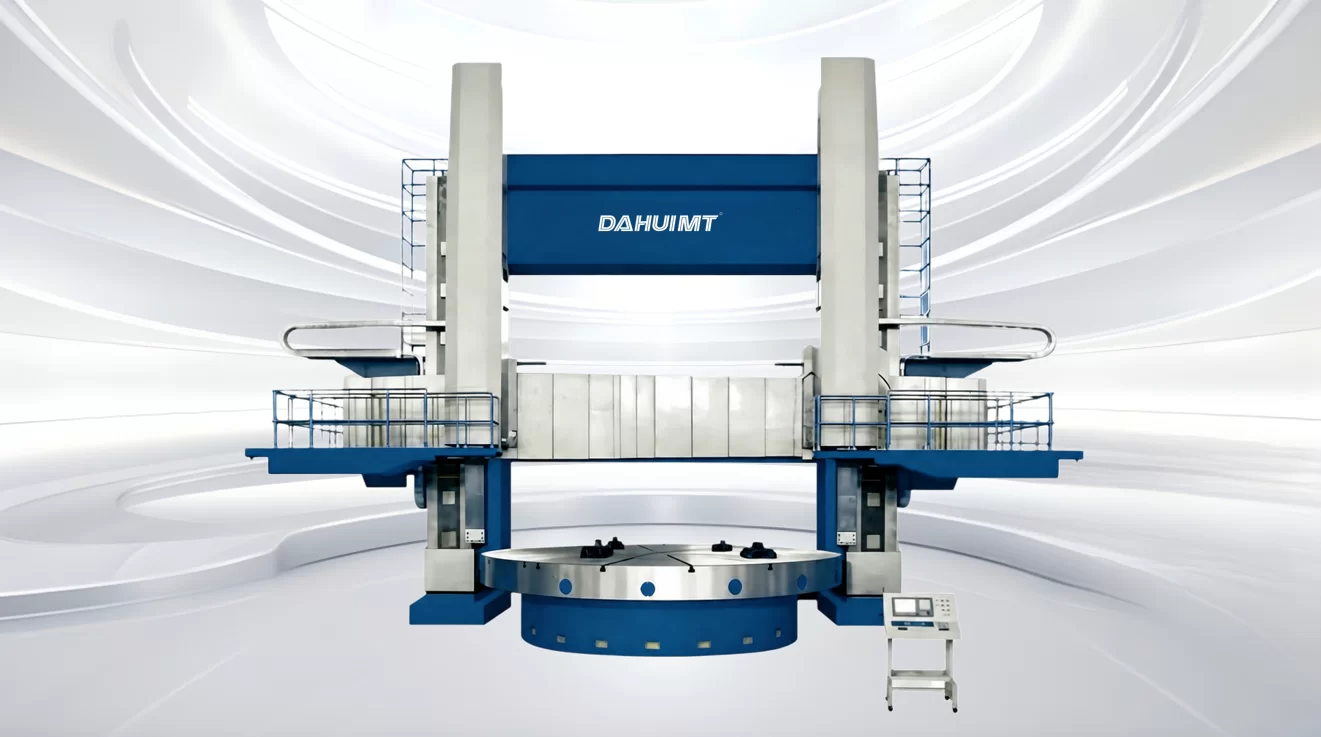
Slant bed vs flat bed lathe: which workpiece suits which
The part decides faster than the specification sheet. Three questions settle most cases.
Diameter, length and mass
- Large discs, rings and flanges — a flat bed keeps the work close to the operator and the load low
- Long shafts needing two or three steady rests — a flat bed gives the room to place them
- Small and medium parts in bar or billet form — a slant bed keeps the working area clear at production rates
- Heavy blanks with interrupted surfaces — either bed works if the casting is heavy enough, but the flat bed is easier to load
Bore and spindle
- Large bar capacity for pipe or tube work — usually a flat-bed configuration with a big bore spindle
- High spindle speed with a smaller bore — usually a slant bed built around a compact headstock
- C-axis or driven tools — more common on slant beds, where the turret arrangement suits it
Where the two overlap — medium discs, short shafts, general jobbing — the decision usually comes down to chip volume and automation rather than to the part, and then the production model decides: a shop that wants to run unattended gravitates to the slant bed.
Automation and the operator
A slant bed is easier to automate because the working area is compact and the spindle is presented at a predictable height and angle. A bar feeder aligns with the spindle without a long, raised support; a gantry loader can reach the chuck from above; a robot cell can be laid out in front of the machine rather than around it. The same compactness is why the enclosure can be smaller, which reduces the volume that has to be cooled and the floor space the machine occupies.
The flat bed’s advantage is the operator’s hands and eyes. Large or awkward parts can be loaded with a crane from above, the tool post is visible and reachable, and a problem in the cut can be seen without leaning into an enclosure. For a job shop running one-off heavy parts, that access is worth more than cycle time.
The test that settles it
Write down the five parts that will occupy the machine for the next two years, with their mass, diameter and batch size. If four of the five can be loaded by hand or by bar feeder, a slant bed will out-produce a flat bed. If two or more need a crane and a steady rest, the flat bed will earn its floor space.
A decision sequence you can defend
Whichever way the slant bed vs flat bed lathe question lands in your shop, work through this order; each step eliminates machines rather than adding features.
| 1. Load and size | Maximum diameter, length and mass, with the workholding and steady rests the part needs. This sets the bed type more often than any other factor. |
|---|---|
| 2. Chip volume | Material removal rate and the material’s chip form. Cast iron dust, stringy steel and aluminium all behave differently in an enclosure. |
| 3. Automation intent | Bar feed, gantry, robot or manual. State it now, because retrofitting automation to a flat bed is a layout project. |
| 4. Accuracy requirement | The tolerance and surface finish that must hold across a shift, and the warm-up discipline the shop will actually follow. |
| 5. Floor space | Front-to-back depth and crane access. A slant bed saves depth; a flat bed needs headroom for loading. |
Two further notes belong in any comparison. First, a slant bed is not automatically more rigid: rigidity comes from the casting and the guideway, and a light slant bed is worse than a heavy flat bed for a heavy cut. Second, a used flat bed in good condition can be the better buy for a shop whose work is large and infrequent — the comparison in new versus used CNC machine covers how to weigh that.
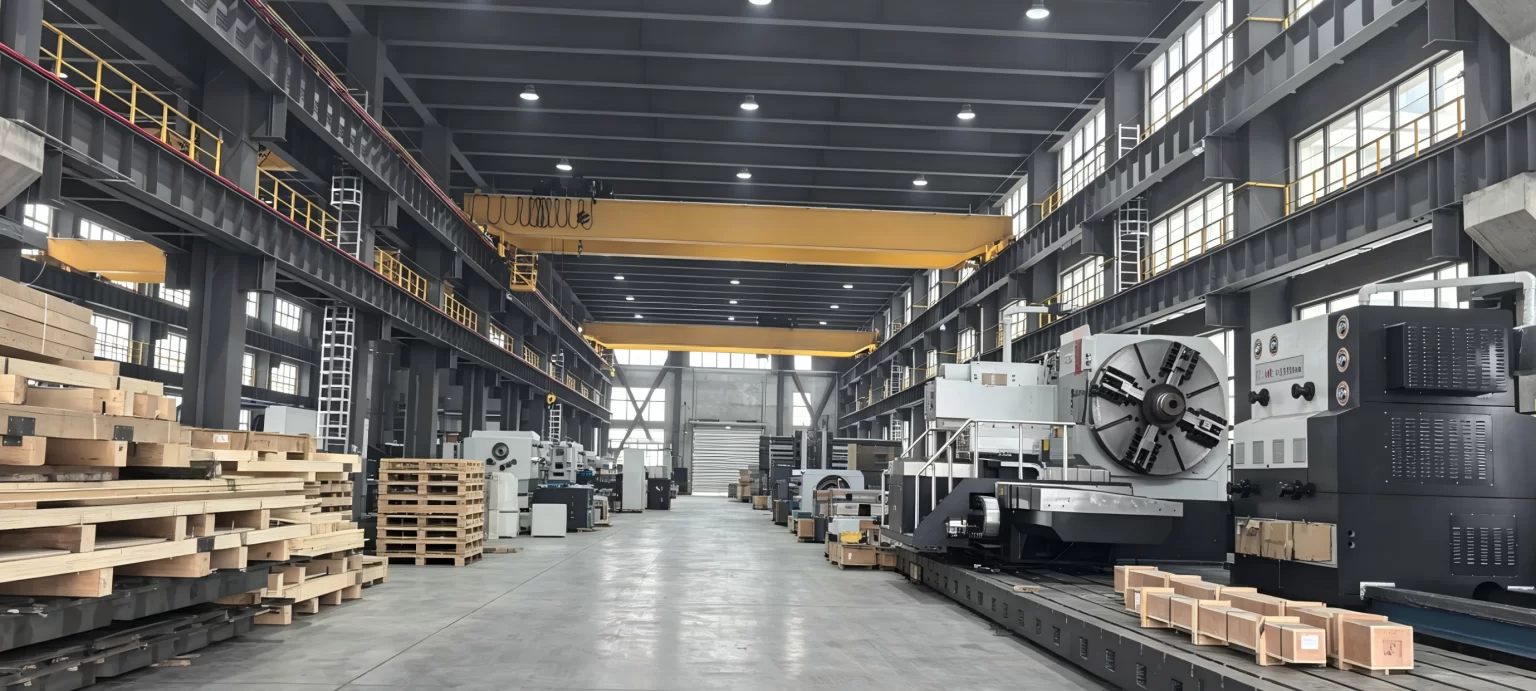
Slant bed vs flat bed lathe: three part families
Most of the argument disappears once the parts are described. These three families cover the majority of turning work, and each points at one bed type for a reason that can be written down.
Small and medium parts from bar. Valves, fittings, shafts under a few hundred millimetres, produced in batches. The machine runs continuously, chips are voluminous and the operator is not standing at the tool. A slant bed is the natural fit: the working area stays clear, the bar feeder lines up with the spindle, and the enclosure can be compact. The slant bed vs flat bed lathe comparison rarely changes the answer here, because the flat bed would need a conveyor, trays and more floor depth to do the same job.
Large discs and rings. Flanges, bearing housings, brake drums, components that arrive by crane. The part dictates the loading method, and loading dictates the bed. A flat bed presents the working area at waist height with open access from above, which is why large-diameter turning still leans that way. At a given swing, a slant bed would have to stand very tall to keep the same rigidity, and the operator would be working over an edge rather than at a bench.
Long shafts with steady rests. Pump shafts, rollers, tie bars. Two or three steady rests have to be placed along the bed, and the tailstock has to reach. The flat bed gives the length and the mounting faces for that arrangement; on a slant bed the same job is possible but the supports become a design exercise. Where a shop needs both long shafts and high-volume bar work, the honest answer is often two machines rather than one compromise.
Frequently asked questions
Is a slant bed more accurate than a flat bed?
Comparing a slant bed vs flat bed lathe on the specification sheet will not answer this. Not in principle. Both are built to a geometry specification, and a well-made flat bed can hold tolerance as tightly as a slant bed. The slant bed has an easier time staying there through a shift because its thermal behaviour is more symmetrical, and it clears chips better, which protects the surfaces that accuracy depends on.
Why are large lathes usually flat bed?
Because the workpiece, not the chip, dominates. A large disc or a long shaft needs to be loaded from above, supported along its length and inspected while it is in the machine. A flat bed gives that access, and at large swing diameters an inclined bed would have to be very tall to keep the same rigidity.
Can a flat bed lathe run a bar feeder?
Yes, and many do. The layout is less compact and the feeder needs more support, but the arrangement is common in shops that also run large work. What a flat bed gives up is the clean, short path from bar to spindle that makes a slant bed convenient for unattended bar work.
Does the bed angle affect tool life?
Indirectly. Better chip evacuation means less re-cutting and a more stable cutting temperature, which usually extends insert life on ductile materials. On a machine where chips pile up, the same insert runs hotter and wears faster, and the difference is often attributed to the tool rather than to the machine.
What angle should a slant bed be?
Thirty degrees suits general work and keeps the turret accessible; forty-five is a common compromise between chip fall and rigidity; sixty is used where chip clearance and operator access to the working area matter most. The angle is a design decision the builder makes, and it should be justified by the work you described.
Send the five parts, and we will tell you which bed
Give us the diameter, length, mass and batch size of the parts that will fill the machine, plus how you intend to load it. We will tell you whether a slant bed or flat bed CNC lathe suits that mix, and why.
Send your part listCompare lathe series
WhatsApp +86 15502628547 · info@dhlathe.com
Include how the part is loaded — crane, bar feeder or by hand. That single answer eliminates more machines than any specification line.
