
Machine Comparison
The 5 axis versus 3 axis machining decision is not about being modern. Five axes buy three specific things: access to compound-angle and undercut features without re-fixturing, the ability to reach deep cavities with a short rigid tool, and the chance to machine several faces against one datum. They cost a more expensive machine, a more expensive CAM and post-processor, and programmers who can think in three dimensions without crashing. If your parts are prismatic with features on one face, three axes plus a fourth-axis indexer will make them faster and cheaper. If they have compound angles or blades, five axes is not an upgrade but the only practical route.
The 5 axis vs 3 axis machining difference
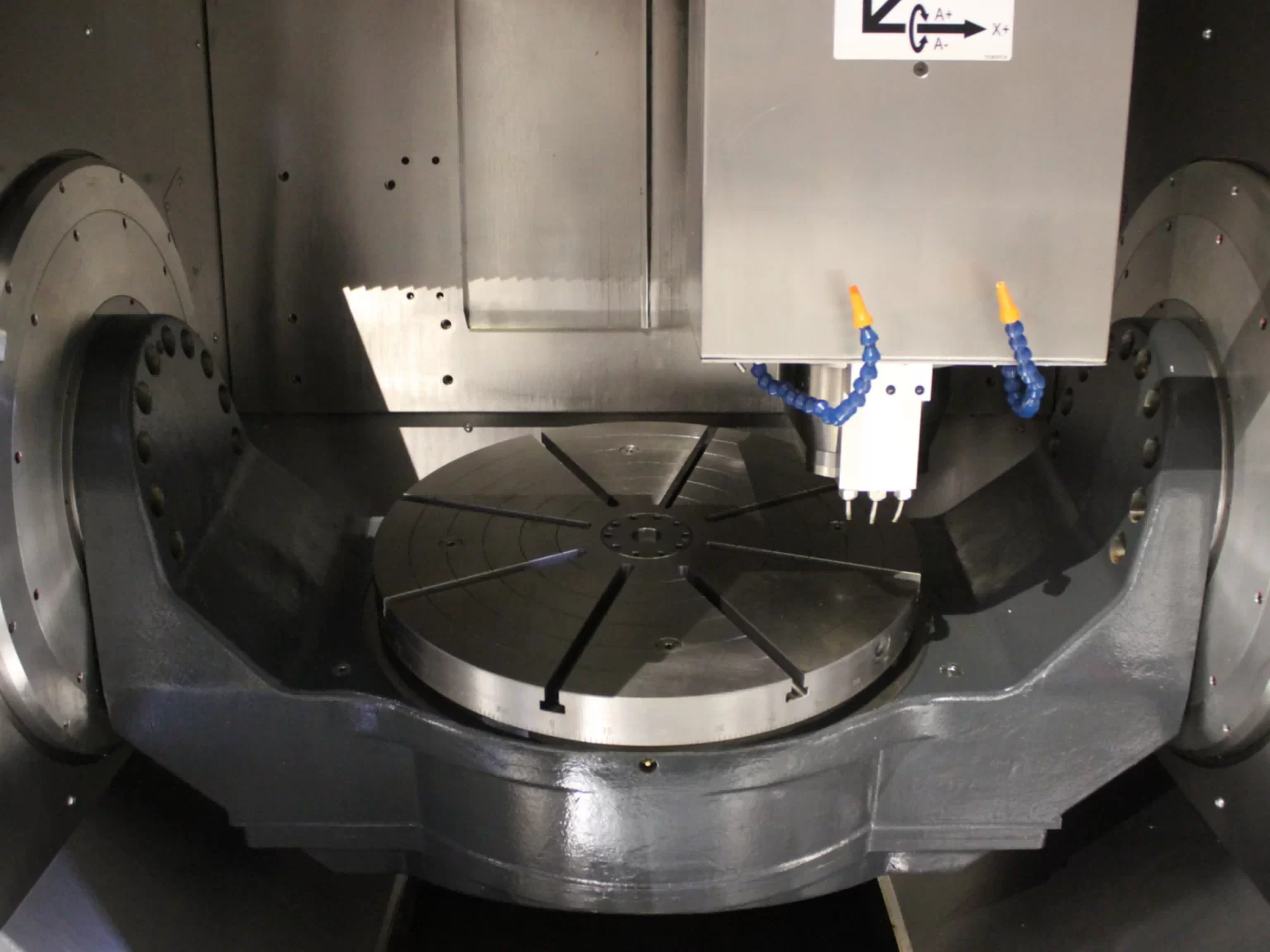
The 5 axis vs 3 axis machining difference begins with what each axis adds. Three axes move the tool in X, Y and Z; two more axes rotate the tool or the table, and the order in which they are applied decides what the machine can do. A trunnion carries the table on two rotary axes; a swivel head carries the spindle. Either way, the cutter can be presented to a surface at an angle, which is the whole point.
| Capability | 3-axis | 3+2 (positional) | Simultaneous 5-axis |
|---|---|---|---|
| Faces per setup | One, plus what the tool can reach from above | Several, by indexing to fixed angles | Several, and curved surfaces in one continuous pass |
| Compound angles | Needs a fixture or a second setup | Handled, at fixed orientations | Handled continuously |
| Tool length in deep cavities | Long tool, deflection, chatter | Shorter tool at an angle | Shortest tool, following the surface |
| Surface finish on complex forms | Faceted, scalloped | Improved, still stepped between orientations | Continuous, best finish |
| Programming difficulty | Low | Moderate | High: CAM, post, simulation, collision checks |
| Machine cost | Baseline | Moderate premium | Highest |
| Rigidity at extreme angles | Best | Good | Reduced; the rotary axes hang the tool further out |
When five axes pays for itself
Compound angles and undercuts. A port, a hydraulic manifold or a bracket with features on non-orthogonal faces cannot be machined in one three-axis setup without a special fixture. Five axes removes the fixture, and with it the setup time and the datum stack.
Deep cavities that need a short tool. In a deep pocket, a three-axis machine has to use a long tool, and a long tool deflects. Tilting the spindle lets a short, stiff tool reach the same floor, which raises metal removal rate and improves the finish at the same time.
Blades, impellers and mould surfaces. Anything with a continuously curved surface that must be cut in one pass is simultaneous five-axis work by definition. There is no three-axis substitute that holds the tolerance.
Datum-critical multi-face parts. When four faces must relate to each other within a tight tolerance, machining them against one datum on one machine removes the accumulation that comes from moving the part between machines.
What it costs beyond the machine
CAM and the post-processor. Five-axis toolpaths need CAM that supports them, and a post-processor that has been proven on the specific machine and control. A generic post is the most common reason a new five-axis machine produces scrap in its first month.
Programming skill and simulation. A five-axis program can collide in ways that a three-axis program cannot, and the operator cannot see it coming. Machine simulation and a disciplined prove-out routine are not optional; they are part of the cost of entry.
Rigidity at the extremes. The rotary axes add stack-up, and at large tilt angles the tool hangs further from the support. A five-axis machine is not automatically stiffer than a three-axis one; at extreme angles it is usually less stiff, which is why light finishing passes are normal there.
Utilisation. A five-axis machine that spends most of its time doing three-axis work has been bought for capability that is never used, and it cost more per hour to own while doing it.
The question that separates 3+2 from simultaneous
Ask whether the tool must move along two rotary axes at the same time while cutting. If the part can be indexed to a series of fixed angles and cut at each one, you need 3+2, not simultaneous five-axis, and the difference in machine price and programming effort is large.
3+2: the middle ground most buyers miss
Positional five-axis, usually called 3+2, indexes the rotary axes to a fixed orientation and then machines as a three-axis job. It gives most of the access benefit — compound angles, short tools in deep cavities, several faces against one datum — without the CAM complexity of continuous five-axis motion.
For a shop whose parts are prismatic but not orthogonal, 3+2 is frequently the correct answer, and it is often available on the same machine as simultaneous five-axis, unlocked by a software option. That is worth checking before paying for a capability you will not program.
Deciding with three questions
| 1. Is any surface continuously curved? | If yes, you need simultaneous five-axis. If every surface is planar or cylindrical, continue. |
|---|---|
| 2. Do features sit on non-orthogonal faces? | If yes, 3+2 removes the fixture and the extra setup. If everything is orthogonal, three axes plus an indexer is enough. |
| 3. Does setup count dominate the cycle? | If the part spends more time being re-fixtured than cut, the extra axes pay back through setups rather than through geometry. |
The control matters here as much as the mechanics: simultaneous five-axis and high-speed look-ahead are usually licensed options, and the post-processor has to match the control. See FANUC versus SIEMENS for how to compare that side, and confirm what is included before comparing prices.
What to write into the enquiry
The part
- The drawing, with compound-angle and undercut features identified
- Which surfaces are continuously curved and which are planar
- The tolerance and surface finish required on the angled features
- The deepest cavity and the tool diameter you intend to use in it
The machine and the software
- Whether simultaneous five-axis is included or a licensed option
- Rotary axis torque, clamping stiffness and the usable envelope at full tilt
- Whether the post-processor and machine simulation are included
- Control model, look-ahead rate, and the training provided on five-axis programming
Moving from three to five axes without losing a quarter
The machine is the easy part of the purchase. The quarter that goes wrong is almost always the transition: the first parts are programmed by someone learning on the job, the post-processor is not proven, and the operator has not seen a five-axis collision before.
Prove the post first. Take one existing three-axis part, program it for the new machine, and cut it before any five-axis work starts. That single step separates machine faults from programming faults, and it is much cheaper to do on a part you already understand.
Then prove one 3+2 job. Positional work exercises the rotary axes, the work offsets and the post without the collision risk of continuous motion. Most shops should spend their first month here, because the 5 axis vs 3 axis machining decision becomes obvious once the operator has indexed a real part.
Only then go simultaneous. Continuous five-axis work needs simulation, a disciplined prove-out routine, and a habit of checking the tool vector before the cycle. Budget the training days with the machine, not after it.
Ask for the post-processor and a simulation seat in the quotation. A machine that arrives without them is a machine that sits idle while the real work happens elsewhere.
One more consideration belongs in the 5 axis vs 3 axis machining decision: what happens when the machine is idle. A five-axis machine that runs two days a week costs more per hour than a three-axis machine that runs five, and capability alone does not recover that difference. The usual way to justify it is to move a whole family of parts onto it rather than one job.
If the parts are prismatic with angled features, a 3+2 machine does the work at a lower cost per hour, and the 5 axis vs 3 axis machining comparison becomes a comparison between 3+2 and three axes plus fixtures. That contest is much closer, and it is decided by setup time rather than by geometry. Count the setups you remove, multiply by the hours each one costs, and compare that annual figure with the price difference: the arithmetic is crude but it is the only version that survives a budget review.
Frequently asked questions
Can a five-axis machine do three-axis work?
The 5 axis vs 3 axis machining comparison is not about the machine’s label. Yes, most of them spend much of their life doing exactly that. The rotary axes index to zero and the machine behaves like a three-axis machine with a heavier table. The cost is that you paid for capability you are not using on those jobs.
Is 3+2 really five-axis?
It uses five axes but only two at a time: the rotary axes position the part, then three axes cut. It is a legitimate and much cheaper way to reach angled features, and it is not the same as simultaneous five-axis motion.
How much more does five-axis programming cost?
It depends on the CAM you already run and whether the post is proven. The reliable way to budget is to ask for the post-processor and a simulation seat in the quotation, then add the training days. Quoting the machine alone is how five-axis projects overrun.
Do I need a special foundation for a five-axis machine?
It is heavier than an equivalent three-axis machine and the rotary axes are sensitive to floor vibration, so the foundation and the siting matter more. Put the site requirement in the enquiry rather than discovering it at installation.
What parts justify five axes on a lathe rather than a machining centre?
Turned parts with angled holes, milled flats or curved slots are usually better on a turn-mill machine with a Y axis and a C axis, which is a different comparison. The machining centre range covers the prismatic side; the turning side is in the lathe range.
Send the drawing, and we will tell you how many axes it needs
Send one representative part with the angled and curved features marked, plus the tolerance and the annual volume. We will tell you whether it needs simultaneous five-axis, 3+2, or three axes with an indexer — and what each route costs to program.
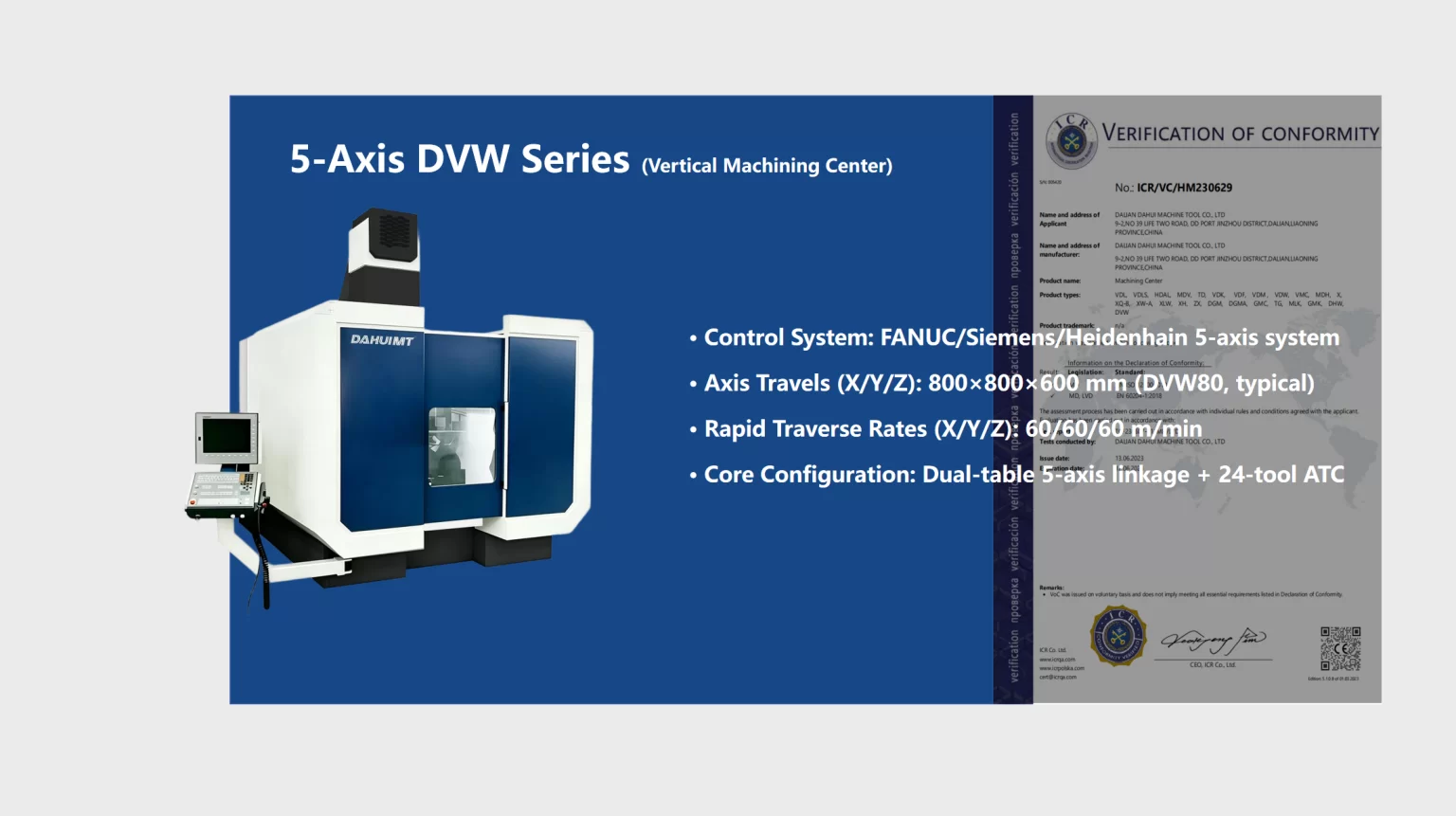
Send your partSee the 5-axis series
WhatsApp +86 15502628547 · info@dhlathe.com
For the 5 axis vs 3 axis machining decision, mark any surface that must be cut in one continuous pass. That is the only feature that genuinely requires simultaneous five-axis.
