
Machine Comparison
The gantry versus moving column machining center choice is decided by which direction the part is long, and by how heavy it is. A gantry machine carries the spindle on a bridge between two columns and the workpiece stays still on a fixed bed, which suits wide, heavy plates and moulds and gives a symmetric, stiff frame. A moving column machine carries the column along a long bed, so the stroke in X comes from the bed length rather than from a table, which suits long parts and gives better access to the ends. Both can be accurate; the wrong one costs floor space, foundation money or reach that you never recover.
The gantry vs moving column machining center difference in one table
The gantry vs moving column machining center comparison is decided by one question: whether the part or the structure travels, and which of them carries the length.
| Behaviour | Gantry (bridge type) | Moving column |
|---|---|---|
| Frame | Two columns and a cross rail; closed, symmetric | C-frame with a column that travels on the bed |
| What moves | The bridge or the spindle carriage; the part stays still | The column travels along the bed |
| Long axis comes from | Rail length and table length | Bed length, which can be extended |
| Part size sweet spot | Wide and heavy: plates, moulds, frames, bases | Long: beams, rails, ways, structural sections |
| Rigidity | High and symmetric; the load path is closed | High, but the spindle overhang varies with Y |
| Part weight effect | Little, because the part does not move | Little in X, but the bed must carry it over its length |
| Loading | Crane access from above and from the sides | End loading of long parts, often with rollers |
| Footprint for a given stroke | Wide; the gantry spans the part | Long and relatively narrow |
What a gantry layout is good at
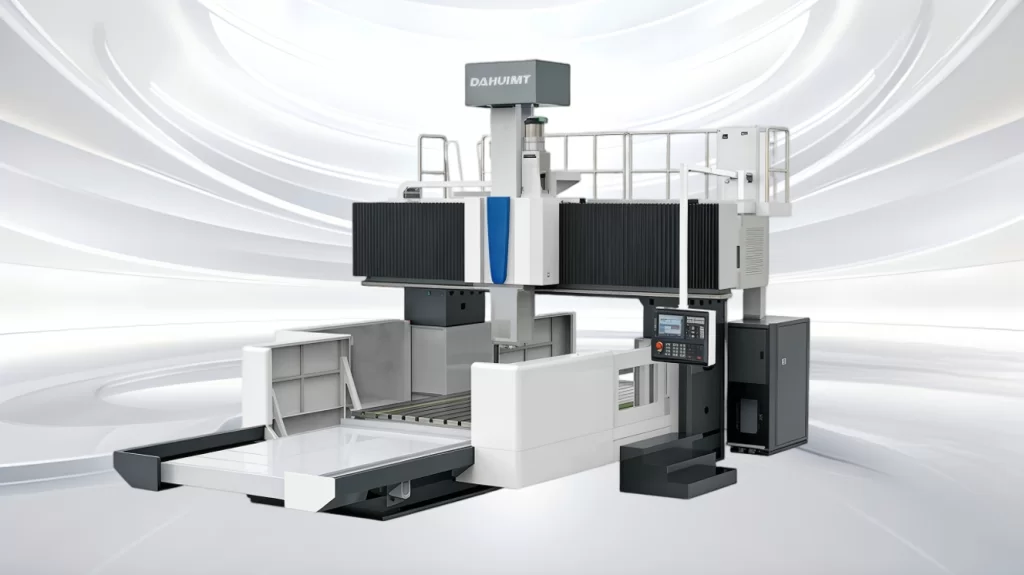
The gantry’s advantage is that the part does not move. A two-tonne plate sits on a fixed bed, the bridge carries the spindle across it, and the machine does not have to accelerate that mass on a table. The frame is closed and symmetric, so the thermal and mechanical behaviour is more uniform than a C-frame, and the stiffness in the cross direction is high because the bridge is supported at both ends.
That makes it the natural choice for mould bases, press frames, machine bases, large plates and any part whose width is comparable to its length. Loading is straightforward: a crane lowers the part onto the bed from above, and the operator can reach both sides of the machine.
The cost is floor area and structure. A gantry that spans two metres is a wide machine, and the foundation has to carry two columns plus the part. For a shop with a long, narrow bay, a gantry may not fit at all, regardless of its technical merits.
What a moving column is good at
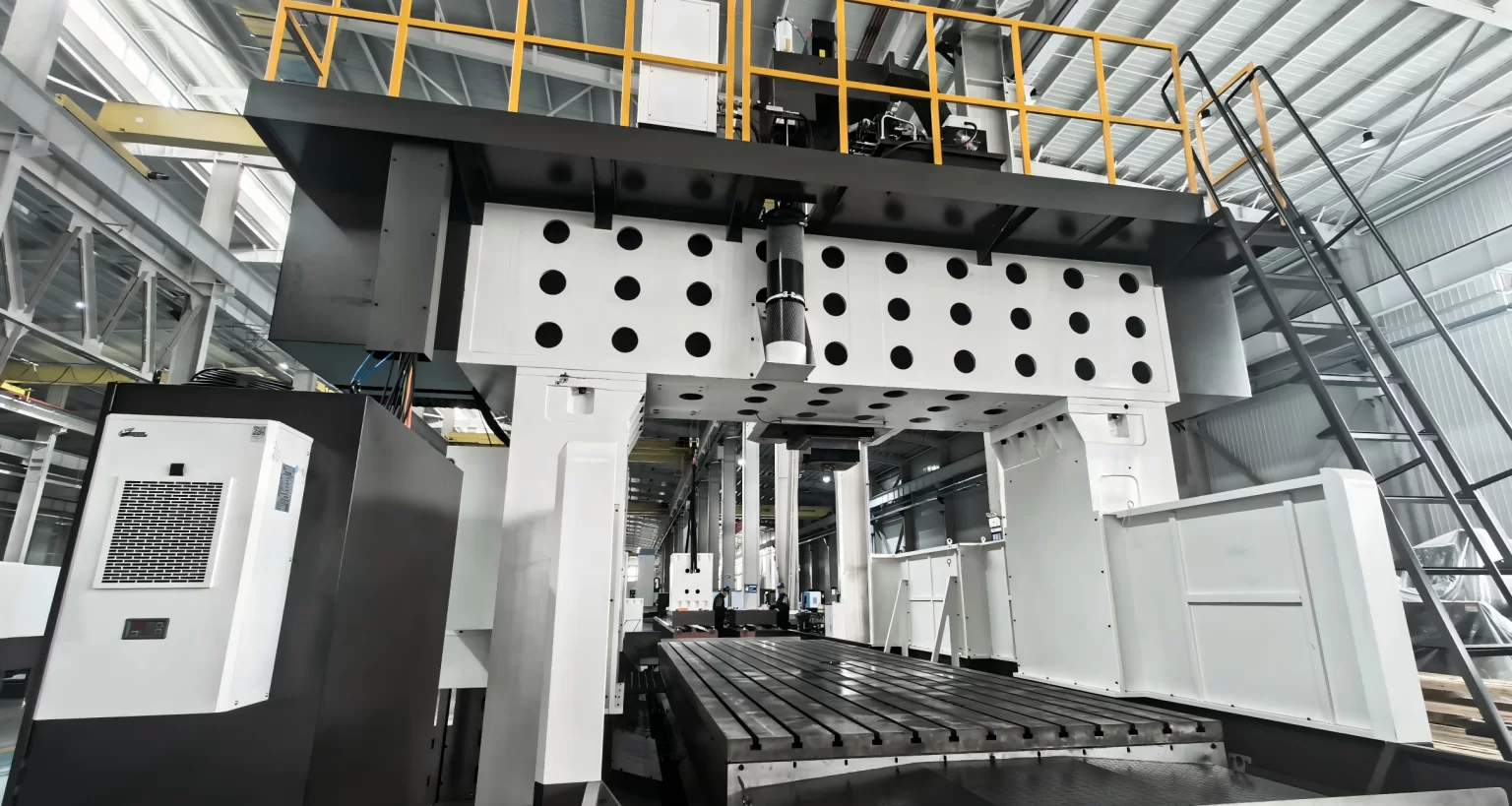
A moving column machine puts the length in the bed. The column travels along it, so the X stroke is limited by the bed rather than by a table, and the part can be loaded from the end and supported along its whole length. For beams, rails, guideways, long structural sections and extruded profiles, that is the geometry that matters.
It also gives better access. The part is open on both ends, so a long workpiece can overhang or be fed through, and fixtures can be placed anywhere along the bed rather than only on a table. For maintenance and for long-part workholding, that is a practical advantage that a gantry cannot match.
The trade is structural: the spindle hangs off a column, so its overhang varies as the column moves in Y, and the bed has to be straight over its full length. A long bed that is not supported evenly will show as a taper or a step in the part, which is why the foundation and the bed’s own geometry carry more weight in this layout.
The question that separates them
Measure the part: if its width is close to its length, the gantry uses the space better. If its length is several times its width, the moving column is the layout that reaches the ends without a machine as wide as the part is long.
The foundation decides more than the brochure
Both layouts are sensitive to the floor, in different ways.
- Gantry: two column foundations must settle equally. Differential settlement twists the bridge, and the error appears as a squareness problem between the two sides of the part.
- Moving column: the bed must be straight and level over its whole length, because the column reads that bed as its datum. A long bed on an uneven floor produces a machine that is accurate at one end.
- Both: thermal gradients along a long structure move the tool relative to the part. A workshop with a door at one end and a heater at the other will show it, whatever the machine.
The guideway type inside either machine matters as much as the layout, and the trade-offs are set out in box way versus linear guideway.
Deciding from the part
| 1. Length to width | Length several times the width: moving column. Width comparable to length: gantry. |
|---|---|
| 2. Mass | Very heavy parts favour a gantry, because the part never has to move. |
| 3. Loading method | Crane from above: gantry. End loading or through-feed: moving column. |
| 4. Bay shape | A wide bay suits a gantry; a long narrow bay suits a moving column. |
| 5. Foundation | Two column pads versus one long straight bed. Whichever is harder to build on your floor is the constraint. |
What to write into the enquiry
The part
- Maximum length, width and height, and the mass of the heaviest part
- The tolerance on flatness, squareness and hole position over the full length
- Which faces are machined, and whether the part is turned or re-set
- Material and blank form — plate, casting, weldment or section
The machine and the site
- Required travels in X, Y and Z, with the spindle nose to table distance
- Spindle taper, power and torque at the largest tool you will use
- Bay dimensions, crane capacity and hook height
- Foundation drawing and the floor’s existing condition
Three part types and the frame that suits them
The comparison becomes concrete once the part has a name. These three cover most of the large work that arrives on a gantry or a moving column.
Mould bases and press plates. Wide, heavy and full of pockets, with a flatness requirement across the whole face. The part does not move, the bridge spans it, and the spindle reaches down into the pockets from a stiff frame. A gantry is the natural machine, and the foundation has to carry two columns plus the plate.
Machine tool beds and beams. Long, narrow and straight, with a guideway surface that has to be parallel over several metres. The length is the dominant dimension, and a moving column keeps the machine narrow while the bed carries the stroke. A gantry long enough for the same part would be an unnecessarily wide building.
Weldments and frames. Big, awkward and inconsistent, often with interrupted cuts and a tolerance that is generous relative to the size. Access and loading dominate: whichever machine lets a crane place the part and lets the operator reach both sides wins, and that is usually the gantry.
For any of these, the guideway inside the machine and the foundation under it matter as much as the frame type. The gantry vs moving column machining center decision sets the layout; those two decide whether it holds tolerance.
Both frames also share one failure mode that is worth stating: they are bought for the biggest part a customer might send, and then run at a fraction of that size for years. The gantry vs moving column machining center decision should be made against the parts you can quote for today, with a margin for the next size up rather than for the largest plate in the region.
A machine that is twice as large as the work costs floor space, foundation, crane capacity and heating, and none of that appears in the price comparison. Size the travels from the part list, check the bay and the hook height against the drawing, and let the gantry vs moving column machining center question settle on which layout fits the building as well as the workpiece.
Keep the foundation drawing with the machine file. When the machine is moved, or when a second one is added beside it, the drawing is what tells the next contractor where the pads are and how they were loaded. Without it, every future installation starts from a guess.
Frequently asked questions
Is a gantry more rigid than a moving column?
In the gantry vs moving column machining center comparison, the gantry frame is more symmetric, which helps, but rigidity depends on the castings and the guideways of the specific machine. A well-built moving column can be stiffer than a light gantry; the layout alone does not decide it.
Can a gantry machine a part longer than its table?
Not in one setup. The stroke is bounded by the rail and the table, so a longer part needs either a longer machine or a second setup. This is exactly the case where a moving column with a long bed is the better answer.
Which is better for mould work?
Moulds are usually wide and heavy with deep cavities, which suits a gantry: the part stays still and the spindle reaches down into the cavity from a stiff bridge. A moving column can do it, but the overhang into a deep cavity is less favourable.
How much floor space does each need?
A gantry needs width across the part plus the columns; a moving column needs length equal to the stroke plus the column travel. Measure the bay before comparing models, because one of the two may simply not fit.
Do both need a special foundation?
Yes, and they need different ones. The gantry needs two pads that settle equally; the moving column needs a long bed supported evenly. The foundation drawing should come with the machine, not after it.
Send the part size, and we will tell you which frame
Send the maximum length, width, height and mass of the part, the tolerance over that length, and the dimensions of your bay. We will tell you whether a gantry machining center or a moving column machine fits the work and the floor.
Send your part and bay sizeSee gantry machines
WhatsApp +86 15502628547 · info@dhlathe.com
For the gantry vs moving column machining center decision, include the bay width and the crane hook height. Either one can rule out a machine that is otherwise perfect for the part.
