
Technical Guide
Thermal deformation in a machine tool is the change in the relative position of tool and workpiece caused by heat. The heat comes from the spindle bearings, the ballscrews, the cutting process, the coolant pump and the room itself, and it arrives unevenly, so the structure bends as well as grows. The result is a part that is correct in the morning and out of tolerance by mid-afternoon, with no fault in the program. Thermo-symmetric design answers it structurally: put the heat sources where their expansion cancels instead of adding, keep the spindle centre close to the machine’s neutral axis, and let the growth happen in a direction that does not affect the part.
Where the heat actually comes from
Most of the heat in a machine tool is generated by the machine, not by the cut. That is why a machine warms up even when it is only moving in air.
| Source | Why it happens | What it moves |
|---|---|---|
| Spindle bearings | Preload plus high speed | Grows the spindle forward along its axis |
| Ballscrew and nut | Recirculating balls under preload | Lengthens the screw, shifting the axis datum |
| Cutting zone | Shear energy and friction in the chip | Heats the part and the fixture locally |
| Coolant | Pump work and heat picked up at the cut | Spreads heat through the bed and tank |
| Hydraulics and drives | Pressure losses and motor losses | Warms the base and the cabinet |
| Workshop air | Doors, sunlight, heaters, time of day | Bends a long structure unevenly |
What it does to the part
A size offset. A spindle that grows forward pushes the tool deeper into the part, so diameters run small. The error is systematic within a warm-up period and then stabilises, which is why the first parts of a shift differ from the rest.
Taper along a long part. A ballscrew that lengthens shifts the carriage position progressively as the axis travels. The part comes out parallel at one end and off at the other, and the error grows with part length.
Drift over the day. Thermal deformation in a machine tool shows up first as drift: a machine that is correct at the start of the shift and out of tolerance three hours later is showing a thermal gradient, not wear. Wear does not reverse overnight; thermal error does.
Geometry error on a large part. When the bed and the column warm at different rates, the squareness between axes changes. On a large part that becomes a position error at the far corner rather than a size error at the tool.
What thermo-symmetric design means
The idea is simple even when the engineering is not: if two heat sources of similar strength sit on opposite sides of the structure, their expansion pushes in opposite directions and largely cancels. If they sit on one side, the expansions add and the structure bends.
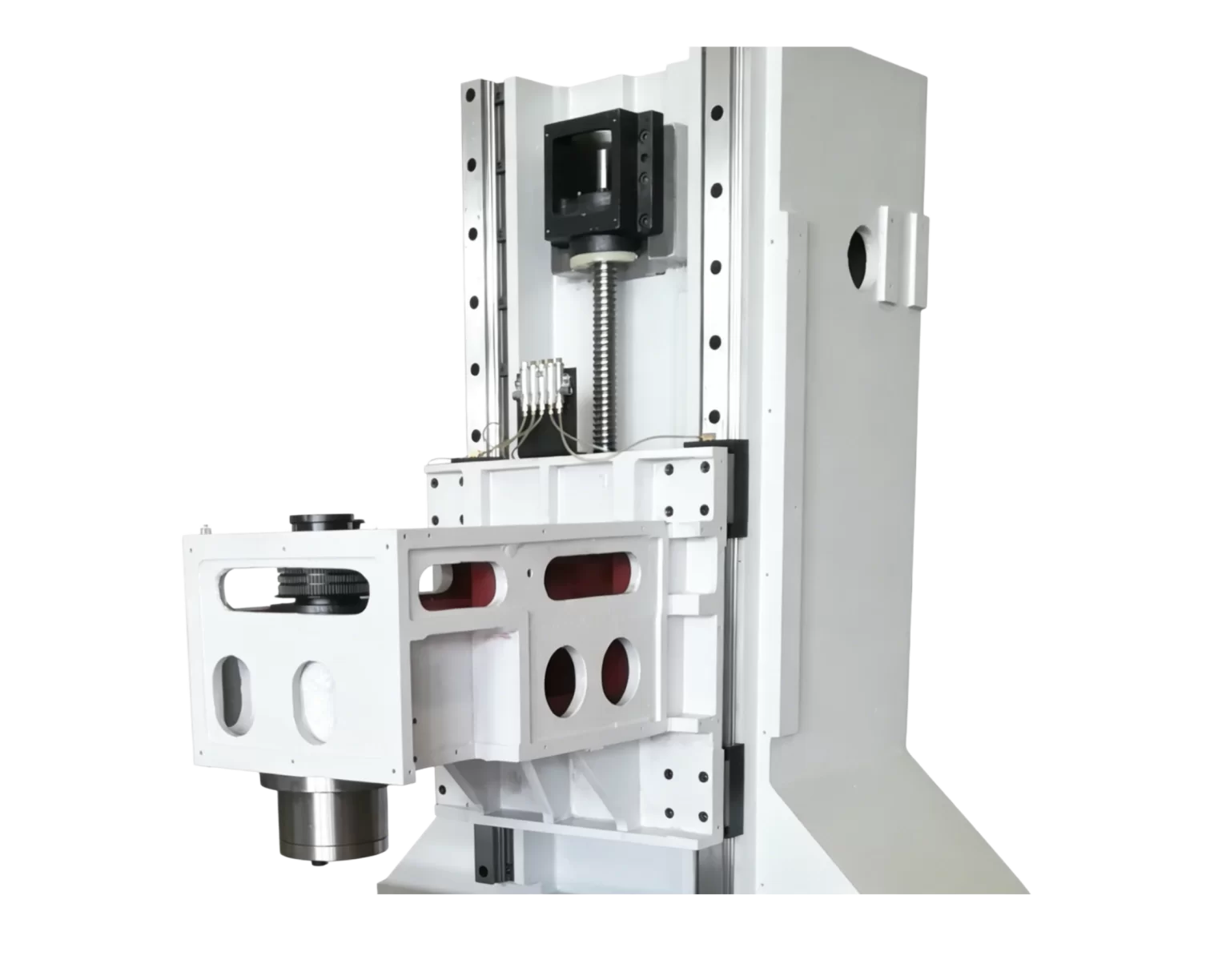
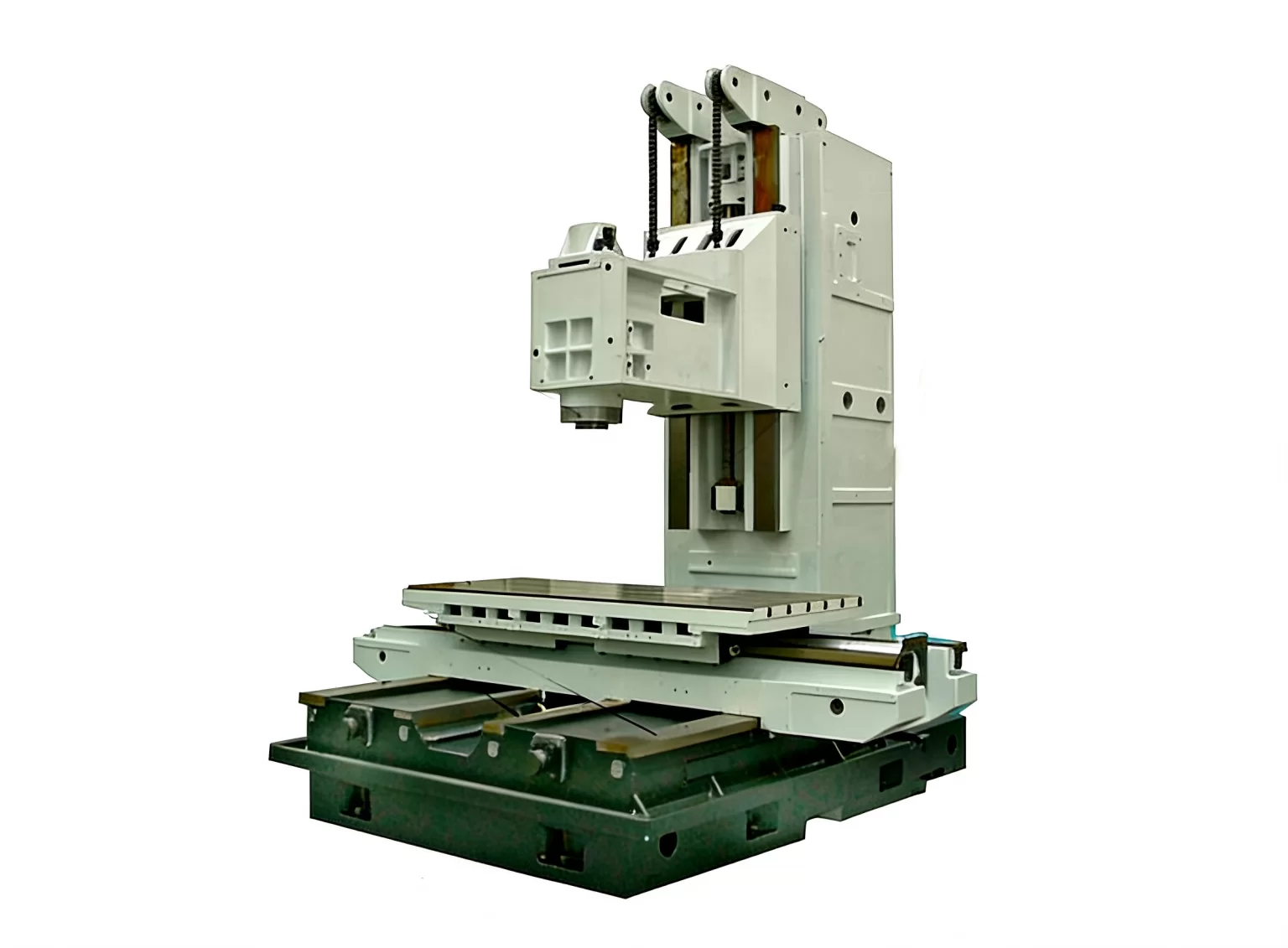
Symmetrical frames. A gantry or a bridge-type structure with two columns is naturally symmetric about the spindle centre. A single-column C-frame is not, which is why it needs more compensation or more careful thermal management.
Spindle near the neutral axis. If the spindle centre line passes close to the centroid of the structure, growth of the structure moves the spindle less in the directions that matter. This is a layout decision made at the drawing stage, not something that can be retrofitted.
Heat routed away from the structure. Coolant tanks, hydraulic power units and electrical cabinets can be placed outside the load path, and spindle cooling can be fed through the housing so the heat leaves before it reaches the frame.
Matched materials. Where two parts must stay in register, similar materials expand similarly. A cast iron bed with a steel column is a deliberate mismatch that has to be managed.
The design question worth asking
Ask where the heat goes, not how much there is. A machine with a hot spindle but a cooling circuit that carries the heat out of the frame will outperform a machine with a cooler spindle and no thermal path.
Control, compensation and the warm-up
Structure is the first line; control is the second. Three methods are used in practice.
- Warm-up cycle. Run the spindle and axes through a fixed program before cutting. It brings the machine to a repeatable thermal state, so the error at the start of the shift is the same every day rather than random.
- Coolant temperature control. A chiller holds the coolant at a set temperature, which stabilises the largest single heat carrier in the machine.
- Sensor-based compensation. Temperature sensors on the spindle and the screw feed a model that offsets the axis position. It works well for repeatable heat sources and needs calibration and maintenance to stay valid.
The practical hierarchy is worth stating plainly. A well-designed structure with a warm-up routine will hold tolerance without sensors. Compensation improves a machine that is already reasonable; it does not rescue one whose structure was laid out badly, because the compensation model is a simplification of a real temperature field.
How to see thermal deformation in a machine tool on your own machine
| Cut the same part first thing | Record the measured size. Repeat after the machine has run for two hours at production speed. |
|---|---|
| Compare the difference | A consistent offset between the two is thermal. A random difference is something else. |
| Check both ends of a long part | Taper that changes over the shift points at the screw rather than the spindle. |
| Watch the room | Note door openings and sunlight. A machine that drifts when the door is open has an ambient problem, not a machine problem. |
| Re-check after a cold start | If the error returns overnight and disappears after warm-up, the diagnosis is confirmed. |
Once you know the size of the effect, you can decide how to live with it: warm up longer, hold the coolant temperature, schedule the tightest work after warm-up, or add compensation. All four are cheaper than scrapping parts to a drift nobody measured.
What to write into the enquiry
The work
- Tolerance on size and position, and over what part length
- Whether the machine runs one shift or continuously
- The ambient conditions: doors, sunlight, heating, seasonal swing
- Whether the tightest work happens at the start of a shift
The machine
- Structural layout and where the spindle sits relative to the frame
- Spindle cooling and coolant temperature control
- Recommended warm-up program and the time to thermal stability
- Whether thermal compensation is fitted, and how it is calibrated and maintained
A shift log that costs nothing
Thermal deformation in a machine tool is easy to suspect and hard to prove, and most shops argue about it instead of measuring it. A simple log settles the question in a week.
Record three things per shift. The room temperature at the start of the shift, the size of one reference feature on the first part, and the size of the same feature on the last part. Nothing else is needed: no instrument beyond the one already used for inspection, no software, no extra time.
Plot the size against the time of day. If the reference feature drifts in one direction and returns overnight, the cause is thermal deformation in the machine tool. If it wanders without pattern, look at the tool, the clamping or the material. If it steps and stays, look for a mechanical cause such as a loose preload or a worn insert.
Repeat after a warm-up change. Once the log has established the size of the drift, change one thing — the warm-up program, the coolant temperature, or the time at which the tightest work is scheduled — and run the log again. If the drift shrinks, the change worked. If it does not, the assumption behind the change was wrong.
Compare seasons. A log kept across a season boundary reveals something a single week cannot: how much of the drift is the machine and how much is the building. Shops that heat in winter and open doors in summer often discover that half of what they blamed on the machine was ambient variation.
Two rules make the log trustworthy. Measure at the same point on the part every time, because a different location measures a different thermal state. And record the coolant temperature alongside the room temperature, since the coolant is often the larger heat carrier and it changes with load rather than with the clock.
A note on instrument choice closes the loop. A contact thermometer on the spindle housing is enough for a shift log, but it measures the surface rather than the bearing, and the two differ by a lag of many minutes. For diagnosing a persistent drift, a clamp-on sensor on the coolant line and a reading at the screw support tell you more than a dozen readings around the casting.
The point of all this is not measurement for its own sake. Thermal deformation in a machine tool is manageable once it is characterised: you warm up for a known time, run the tight work in the stable window, and stop blaming the operator for a drift that the process created. What cannot be managed is an effect nobody has quantified, which is exactly where most shops start.
Frequently asked questions
How long does a machine take to warm up?
It depends on the mass and the spindle speed. Large cast structures take longer than small ones, and a high-speed spindle reaches stability faster than a large slow one. The machine supplier should be able to give a warm-up program and a time, and that time belongs in the production plan.
Can thermal deformation be eliminated?
Not entirely, because heat is generated by the process itself. It can be made small, repeatable and predictable, which is what production actually needs.
Does a bigger machine suffer more?
It moves more in absolute terms because the structure is longer, but it also has more mass and usually better symmetry. What matters is the design and the temperature gradient, not the size alone.
Is compensation a substitute for warm-up?
No. Compensation offsets a modelled error; warm-up removes the transient. Using compensation on a cold machine means compensating for a state the model does not describe.
Why does the error change with the season?
Because the workshop’s baseline temperature changes. A machine calibrated in winter and used in summer sees a different ambient, and the structure starts from a different state. Recording the room temperature with the first-article measurement makes the pattern visible.
Tell us the tolerance and the shift pattern
Send the tolerance, the part length and whether the machine runs one shift or continuously. We will tell you how the gear machine structure handles heat, what warm-up it needs, and whether compensation belongs in the specification.
Describe your processSee the series
WhatsApp +86 15502628547 · info@dhlathe.com
For any thermal deformation machine tool question, the first number to ask for is the time to thermal stability.
