
Buying Guides
A CNC machine lead time is quoted per machine, and the band it falls in is 30 to 90 days. Where your machine lands inside that band is decided by four things running at the same time: the castings and the machining of the beds, the bought-in components inside the machine, how far the build departs from a standard configuration, and the final test, packing and freight. The clock starts when the technical specification and the order are frozen — not when the enquiry is sent. Use the band to plan your project; the exact date is subject to the technical agreement confirmed with the order.
Why a lead time is not one number
A machine tool is assembled from parts that have very different waiting times. Some are catalogue items that can be picked from a shelf the same week. Others — the castings, the spindle unit, the control with the options you specified — are made to order, and no amount of pressure compresses the physical work in them.
So the number in a quotation is really the longest link in the chain, plus everything that has to happen after it clears. A standard lathe with a standard control and standard workholding has a short chain. The same lathe with a non-standard spindle, a special chuck, a custom bed length and a control option that has to be built in changes the chain completely, even though the two machines would look identical on a quotation.
This is the same logic that governs the machine choice itself: the decision framework in how to choose a CNC lathe ends with a configuration, and the configuration is what the lead time is actually built from. A buyer who can read the chain can do two useful things — shorten the wait where it is genuinely compressible, and plan the rest of the project around the parts that are not.
The four clocks that run at the same time
The band you are quoted is decided by these four. Ask which of them sets the outer edge of your date.
Castings, stress relief and bed machining
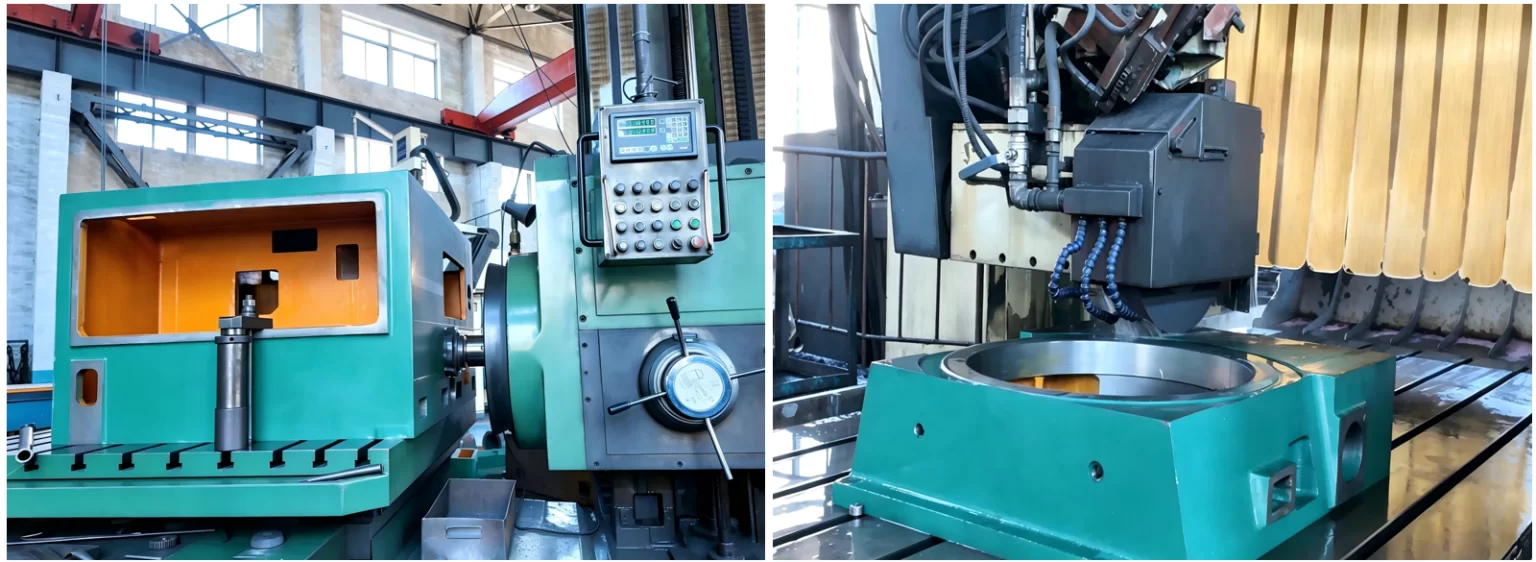
Beds, columns, saddles and headstocks begin as castings. The pattern has to exist, the casting has to be poured, and the casting then has to sit and relieve its internal stress before it is machined — skipping or shortening that settling time does not show up on a test certificate, it shows up as a bed that moves after the machine has been in service for a while. Rough machining, settling again, then finish machining of the guideway surfaces is what turns a casting into a machine base.
For a standard model the pattern already exists and the casting is a known item. A longer bed, a different centre height or a changed guideway arrangement means a new pattern and a new casting, and that is usually where the outer end of a quoted band comes from.
Bought-in components
The CNC control and its servo drives, the spindle unit, the ballscrews, the linear guideways or hardened box ways, the bearings, the turret or tool magazine, the measuring scales: each of these arrives from a specialist supplier, and each has its own order book. The machine can only be assembled when the last of them is on the floor, which is why an unexpected wait is so often traced to one bought-in item rather than to the builder’s own work.
Two practical consequences follow. First, the options matter: a control series, a drive package or a spindle specification that is not a standard configuration for that model brings a delivery time of its own. Second, the components are usually ordered against the confirmed order, so the deposit timing and the component ordering run in parallel — a slow confirmation delays those components even when the plant is otherwise ready.
How far the build departs from a standard machine
Every machine is answered on its own: a standard model with standard options is built from a design the plant already has, while a machine with a longer bed, a different centre height, a special spindle bore or taper, an unusual guideway arrangement or a bespoke workholding setup carries engineering with it. A drawing has to be made or adapted, and the parts that change have to be ordered against that drawing.
This is the part of the band a buyer controls most directly. The DAHUI MT CNC lathe range shows the models and configurations that follow an existing design; anything outside that list is quoted as an engineered machine, and the quotation should say which of its parts are new.
Final test, packing and freight
Before a machine is dismantled for transport it is aligned, run and tested, and the geometry is recorded. Then it is broken into transport sections, treated against corrosion, crated and loaded. This stage is short in the factory and long on the water: sea freight, port handling and customs clearance add a tail that is measured in weeks and moves with sailings, congestion and inspection rather than with planning.
Which of that tail the supplier owns depends on the delivery term, and the term decides when the lead time actually ends for you. The difference between handing over at the factory and delivering to your site is set out in the Incoterms rules published by the International Chamber of Commerce; agree the term before comparing two dates.
What keeps a build near 30 days, and what pushes it toward 90
| Driver | Keeps the date near 30 days | Pushes it toward 90 days |
|---|---|---|
| Castings | A standard model whose pattern exists and whose bed has been cast before | A new pattern, a longer bed or a changed centre height, with a settling time that cannot be shortened |
| Components | Standard control series, standard spindle, catalogue guideways and drives | A special spindle bore or taper, an uncommon control option, or an imported item on a long delivery |
| Configuration | A build that follows the current design, with standard workholding and tooling | New drawings, bespoke workholding, a specific automation interface, or a special packing requirement |
| Testing and freight | A standard test cut, standard crating, a direct sailing to your port | Additional acceptance tests, a special transport split, or a route with transhipment and clearance checks |
What actually starts the clock
A CNC machine lead time is usually quoted from one of two points, and the difference between them can be several weeks. The point that matters is the one where the factory can commit materials and engineering: a frozen technical specification, a confirmed order with the payment instrument in place, and no open technical questions. Until all three exist, the date you are given is an estimate rather than a commitment.
The specification is the one that is most often underestimated. The machine configuration, the options, the workholding, the tooling package and the acceptance criteria decide which castings and which bought-in components have to be ordered. Every week in which those are still being revised is a week in which the long-lead items have not been ordered.
Changes after the order are where dates move. A different spindle specification or a larger chuck is not an edit to a document: it is a different component with its own delivery time, and it can carry the build past the figure you were quoted.
Need your own date rather than a range? Ask our engineering team where your machine falls in the band →
How to read the lead time on a quotation
A CNC machine lead time is only usable if it can be audited, which means the quotation should say what the figure means. These are the lines worth insisting on — and they decide whether two offers are comparable, just as the cost drivers in what actually drives CNC lathe cost have to be normalised first.
| Line | What it should say | What a vague line hides |
|---|---|---|
| Starting point | The exact event the clock starts from: specification frozen, order confirmed, deposit received | A lead time counted from the enquiry, which the factory never saw |
| Breakdown | Weeks against castings and bed machining, bought-in components, build and testing, packing — with the driver that sets your date named | A single figure with no indication of what puts it near the near end or the far end of the band |
| Delivery term | The named Incoterm and the exact point of handover | “Delivery” left open between the factory gate and your site |
| Testing | Whether the alignment record and the test cut happen before shipment, and against which criteria | Acceptance criteria invented on the day of commissioning |
| Documents | The document set handed over, listed item by item | Documents promised “with the machine” and never enumerated |
| Changes | What a configuration change after the order does to the date | A date that is quietly re-based at every revision |
The delays that are not the factory’s fault
Most CNC machine lead times that overrun are not caused by the machine being slow to build. They are caused by work that sits with the buyer or with transport, and neither is visible in the quotation.
Delay that belongs to the buyer
Drawings or a sample part that arrive late, an approval that waits for a signature, a payment instrument that is issued after the components were supposed to be ordered, a foundation that is not ready, or shipping documents that are prepared only once the machine is already at the port. Each of these moves the date without the factory doing anything wrong, and each is entirely within the buyer’s control.
Delay that looks like the factory but is not
An imported control or spindle held at a supplier, a vessel booking that is rolled to the next sailing, port congestion, or a customs inspection of the components rather than the machine. None of these can be planned away, and all of them are reasons to keep a margin between the quoted date and the date you promised your own customer. The paperwork and verification that cross-border purchases require are set out in the checklist for buying a CNC machine from China.
Shortening a lead time without paying twice
Some of a CNC machine lead time can genuinely be removed. Compressing something that cannot move — casting settling time, a vessel’s sailing — transfers cost without transferring time.
Do this
- Freeze the specification and the acceptance criteria before the order, not after
- Ask which phase is the longest pole, and plan your own works around that phase
- Take a standard control and spindle configuration when the drawing does not require otherwise
- Confirm the component list that has to be ordered in advance, and confirm it in writing
- Prepare the foundation, services and access while the machine is still being built
Avoid this
- Revising the configuration after the components have been ordered
- Treating a single quoted figure as a plan, with no breakdown behind it
- Leaving the deposit until after the long-lead components should have been ordered
- Assuming freight and clearance are inside the lead time when the term says otherwise
- Cutting the run-in or the test cut short to gain a few days at the end
Planning your build and your cash around the date
The date is only useful if the work around it is sequenced to match. This is the checklist that turns a quoted CNC machine lead time into a project plan.
Before the order
- Workpiece drawing, material, tolerance and annual volume documented
- Machine configuration and options frozen, including workholding and tooling
- Acceptance criteria and the test part agreed in advance
- Delivery term and handover point agreed and named in the offer
While the machine is being built
- Deposit and payment instrument issued against the agreed schedule
- Foundation, floor loading, access route and services prepared in parallel
- Operating personnel and maintenance staff identified for training
- Site power, compressed air and coolant provision completed before arrival
Before it ships
- Pre-shipment photographs and the alignment record received and reviewed
- Shipping documents drafted and checked against the letter of credit
- Unloading equipment, rigging and a positioning plan arranged for arrival
- Production and cash-flow plans built on the handover date, not the order date
The alternative worth measuring against that plan is a used machine, which trades waiting time for condition risk; the two are compared line by line in the new versus used total cost of ownership comparison.
How to hold a supplier to a date
A CNC machine lead time is a commercial commitment, so write it the way commitments are written — with a definition, milestones and a named person on each side.
| Definition of the clock | The event that starts the lead time, written as a condition that either party can verify |
|---|---|
| Milestones | Dates or weeks for castings, component arrival, build, testing and packing, with the driver that sets the date identified |
| Change control | Who approves a configuration change, and how the date is recalculated when one is approved |
| Acceptance protocol | The measurements and the test part that have to be signed off, and by whom |
| Documents and terms | The document set at handover and the delivery term that fixes where the lead time ends |
Frequently asked questions
How long is a CNC machine lead time?
Typically 30 to 90 days from the point where the specification is frozen and the order is confirmed. The near end of that band is a standard model with standard options, where the castings and every bought-in component are known items. The far end is a machine with a non-standard casting, a special spindle or control option, or a build that needs new engineering. Because every machine is quoted on its own, use the band to plan and the confirmed date to commit.
Does a shorter lead time cost more?
Usually, if the compression is real rather than a redefinition of the starting point. Holding a casting back from settling, buying a component from the open market instead of the regular supply route, or moving a machine by air instead of sea all transfer cost into the price. The question worth asking is which phase is being compressed, because shortening a step that was never the longest pole buys nothing.
Is lead time the same as delivery time?
No. Lead time covers the work of building and testing the machine. Delivery time adds the freight, port handling and clearance tail, and how much of that the supplier carries depends on the delivery term. Two offers can quote the same lead time and still reach your site weeks apart, which is why the handover point has to be named before dates are compared.
Can a quoted date be held once it is agreed?
It can be tracked rather than assumed. A date holds when the specification is frozen, the payment instrument is issued on schedule and the milestones are reviewed against a named contact on both sides. If the configuration changes after the order, the honest response is a recalculated date rather than the original one repeated.
What information do you need to give a firm date?
The workpiece drawing with the material and the tolerance you must hold, the annual volume, the machine configuration and options you want, the workholding and tooling, your delivery term and destination, and the date you need the machine in production. With those on the table, the components and the drawings can be checked, and the date can be given against the driver that sets it rather than as a blanket figure.
Next step
Ask for your own date, not a brochure figure. Send the part you need to make and the configuration you are considering, and our engineering team will tell you where your machine falls in the 30 to 90 day band, which driver sets it, and the delivery term that puts the handover point where your project needs it.
Ask for the date on your configuration
WhatsApp: +86 15502628547 · Email: info@dhlathe.com
Send the workpiece drawing, the tolerance and your required production date with the enquiry — the date we return is built on those, not on a blanket figure. The exact date is subject to the technical agreement confirmed with the order.
