
Technical Guide
The turning vs milling difference comes down to which element rotates. In turning, the workpiece spins and a single-point tool is fed into it, producing surfaces of revolution around one axis. In milling, the tool spins and the workpiece is moved under it, producing flat faces, slots and pockets in any orientation. Boring enlarges and trues an existing hole with a single-point bar, usually on a part that is already positioned; drilling creates the hole in the first place with a two-flute tool. Two of the four rotate the work, two rotate the tool, and that single fact predicts which operation belongs on which machine.
The four processes in one table
The turning vs milling question is the one buyers ask first, but the same logic separates boring from drilling. Read the table by column three: it tells you what shape each process is capable of producing.
| Process | What rotates | Shape produced | Typical use |
|---|---|---|---|
| Turning | The workpiece | Cylinders, tapers, faces, grooves, threads | Outside diameters and end faces of round parts |
| Boring | The workpiece (or the tool, on a boring mill) | An existing hole made larger, rounder and true to a datum | Bearing seats, pin holes, housings |
| Milling | The tool | Flat faces, slots, pockets, profiles, keyways | Prismatic parts and non-round features |
| Drilling | The tool | A hole along the tool axis | Creating the hole before boring or tapping |
Work rotates: turning and boring
Turning and boring both hold the part on a rotating axis, so the resulting geometry is a surface of revolution that is concentric with that axis by construction. That is a powerful property: the outside diameter and the bore of a bushing machined in one setup are concentric without any measurement, because the machine never re-clamped the part.
The distinction between them is where the tool cuts. Turning works on the outside, reducing the diameter to size. Boring works on the inside, enlarging a hole that already exists — usually one produced by drilling or by a casting. A borer is used rather than a drill when the hole must be true to the outside diameter, straight through a long length, or held to a tolerance a drill cannot reach.
This is why the turning vs milling decision usually comes down to whether the tolerance-bearing features are concentric with the part axis. If they are, turning and boring do the job in one setup and the geometry is free. If they are not, the part has to go to a machine that can reach off-axis features.
Tool rotates: milling and drilling
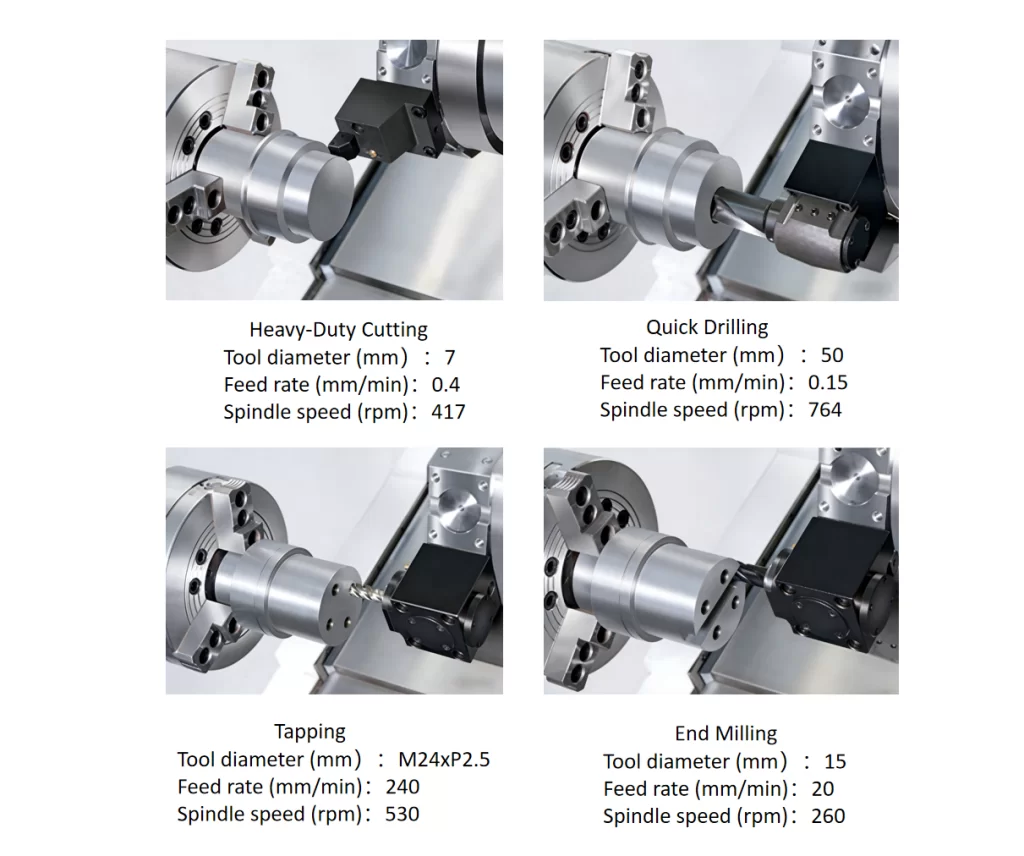
Milling rotates a multi-tooth cutter and moves the work under it. Because the tool can approach from any direction in three axes, milling produces features that have no relationship to a single centreline: flat faces, square shoulders, pockets, slots, keyways and contoured surfaces. The shape comes from the path the cutter centre follows, not from the rotation of the part.
Drilling is a special case of tool rotation with one job: create a cylindrical hole along the tool axis. A drill is efficient at removing volume but it is not a precision tool — it wanders on an inclined surface, follows its own point geometry, and leaves a hole that is usually neither straight nor round enough for a bearing. That is why a drilled hole is normally followed by boring or reaming.
Understanding this sequence removes most of the confusion around quoting. A housing with a bore does not need "a boring machine"; it needs a drill to open the hole, a boring bar to bring it to size, and possibly a mill to face the mounting surface — which may all happen on one machining centre.
The question that sorts any feature
Ask whether the feature is a surface of revolution around the part axis, or a shape defined by a tool path. Round and concentric: turning or boring. Everything else: milling, drilling, or both.
Reading the drawing to choose between turning vs milling
A drawing rarely says which process to use; it shows geometry and tolerance. For the turning vs milling decision, work through it in this order.
| 1. Dominant form | If the part is mostly a body of revolution, start with turning. If it is box-shaped or plate-like, start with milling. |
|---|---|
| 2. Datum relationships | Features that must be concentric with the main axis want one turning setup. Features that must be square to a face want milling. |
| 3. Hole requirements | A drilled hole is a starting point; a bearing seat needs boring or reaming afterwards. |
| 4. Tolerance and finish | Fine finishes and tight diameters are easier to achieve on the machine that cuts them continuously, not in interrupted passes. |
| 5. Quantity | High volume justifies a dedicated setup per operation; small batches favour doing everything in as few setups as possible. |
Two consequences follow. First, a part can be cheap on one route and expensive on another purely because of setup count, not cutting time. Second, the same drawing quoted by two suppliers can describe two different process plans — which is why asking "which operations and how many setups" makes quotes comparable.
When one machine does several
Machine design has spent decades eroding these boundaries, and the turning vs milling distinction is now a matter of default rather than a hard rule.
- Turn-mill machines add live tooling and a C axis to a lathe, so cross-drilling, flats and slots can be cut without a second operation. The part stays on one axis datum.
- Machining centres with a rotary table bring four or five faces within reach, which reduces the number of separate mill setups.
- Boring mills combine a rotating spindle with a large facing head, and handle big housings that would not fit on a lathe.
The trade is rigidity and simplicity. A dedicated lathe is stiffer and cheaper than a turn-mill of the same size, and a dedicated machining centre is stiffer than a lathe trying to mill. Combine operations when the setup saving is real, not because the brochure lists the capability.
What to send in an enquiry
The part
- The drawing, with the datum faces and the axis marked
- Which features must be concentric, and which must be square to a face
- Hole sizes, depths and whether each is a bearing seat or a clearance hole
- Material, blank form and the largest overall dimension
The process
- Whether one setup is required, or whether re-clamping is acceptable
- Tolerances that matter, and the finish required on each surface
- Annual quantity and batch size
- Whether heat treatment or coating follows machining
A worked example: one housing, four processes
Take a bearing housing: a rectangular body, a large bore through it, a machined mounting face, and four bolt holes on the face. It is not a "turning part" or a "milling part"; it is both, and the turning vs milling question only makes sense once the features are separated.
The bore is the tolerance-bearing feature. It must be round, straight and true to the mounting face. Drilling opens it; boring brings it to size. If the housing is a casting with a rough bore, boring removes the cast skin and establishes the datum.
The mounting face must be square to the bore, so the order matters: machine the face first, then bore from it, or bore first and face afterwards on the same setup. Doing them on two machines means the squareness depends on two fixtures rather than on one spindle.
The bolt holes are position-toleranced to the bore centre. They are drilled and tapped on a machining centre, ideally in the same setup as the face, so the position error is measured from the same datum the bore was cut from.
The outside is usually left as cast or sawn. Facing it is a convenience, not a requirement, and adding it increases the setup count without improving the function.
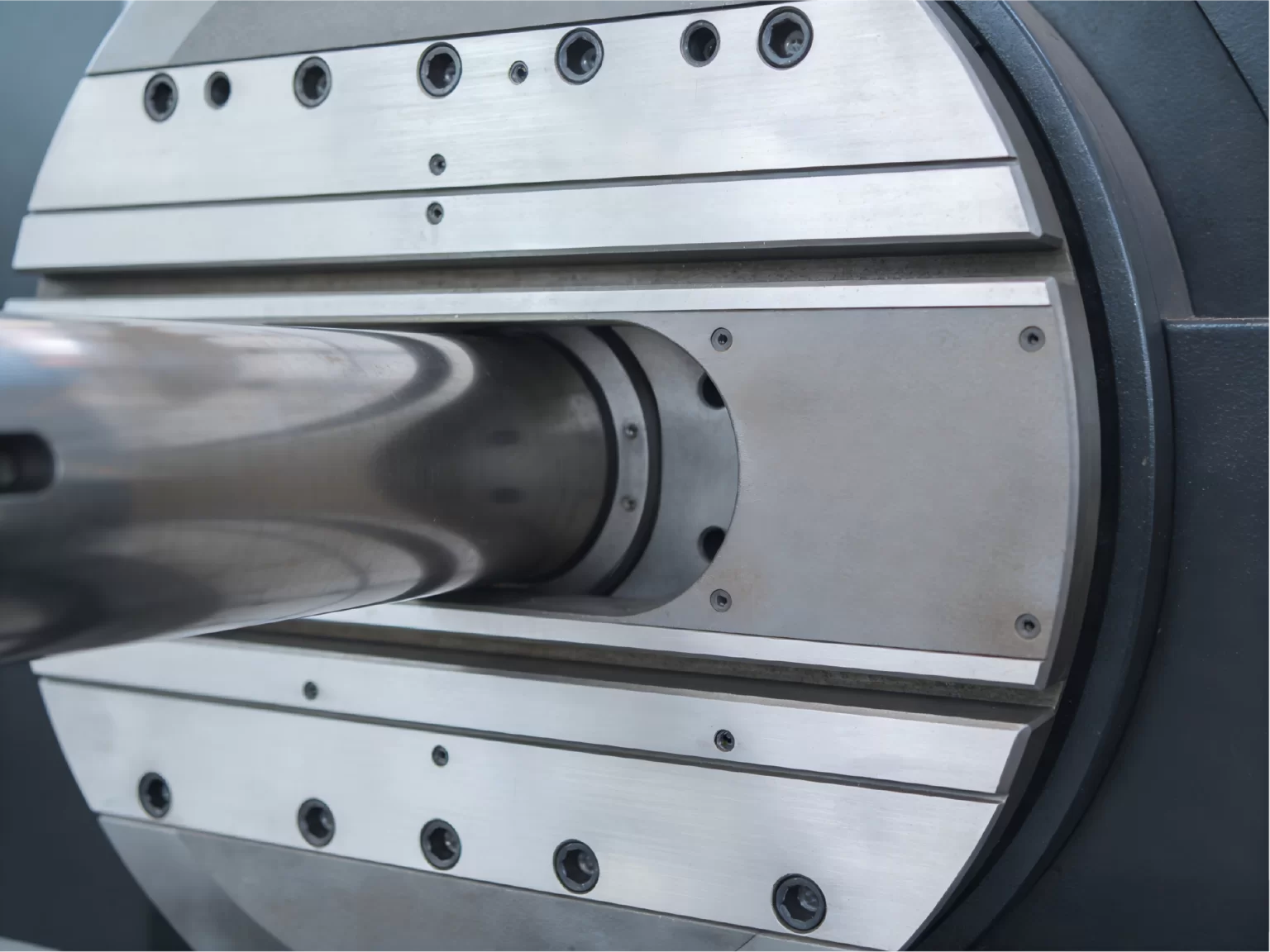
Seen this way, the turning vs milling choice is really a question about setups. If the bore and the face can be cut without re-clamping, the housing holds its squareness for free. If they cannot, the part depends on the quality of two fixtures and an operator’s care, and the tolerance you can promise drops accordingly.
That is also why quotes for the same housing can differ substantially. One supplier machines the face and the bore in one setup on a boring mill and drills the bolt holes in a second; another turns the bore on a lathe, moves the part, mills the face, then drills. Same drawing, same material, two very different capability statements.
Frequently asked questions
Can a milling machine do turning?
Not practically. A mill rotates the tool against a stationary workpiece; a round part can be indexed on a rotary table but it cannot be turned continuously. Some lathes can mill with live tooling, but the reverse is rare.
Why bore a hole when you can drill it?
Because a drill is a roughing tool. It leaves a hole that may be oversize, tapered or off-centre, and it cannot correct an existing error. Boring is a single-point operation that brings the hole to size and true to a datum, which is what a bearing seat requires.
Is boring the same as internal turning?
Mechanically they are the same motion: a single-point tool cutting on the inside of a rotating part. The word boring is used when the purpose is to size or true an existing hole rather than to produce the primary form.
Which process gives a better surface finish?
It depends on the tool and the parameters, not the process name. A fine finish pass in turning and a fine finishing cut in milling can both produce smooth surfaces. Interrupted cuts, such as milling across a slot, make a fine finish harder to hold.
Do I have to choose one supplier per process?
No, and you usually should not. A supplier with turning, milling and boring capability can keep the part in one factory and control the datum chain. Splitting processes across suppliers adds freight and re-fixturing, and it moves responsibility for the final tolerance to nobody in particular.
Send the drawing, and we will tell you which operations
Send one part with the datum faces and the tolerance-bearing holes marked, plus the annual quantity. We will tell you how many setups it needs on turning and on milling, and whether a boring and milling machine does it in one.
Send your partSee boring and milling machines
WhatsApp +86 15502628547 · info@dhlathe.com
For the turning vs milling decision, mark the features that must stay concentric with the main axis. They decide whether the part can be finished in one turning setup.
