
Operation & Maintenance
A ball screw fails gradually and then suddenly. The gradual part is backlash that grows, a surface finish that drifts and a size that moves; the sudden part is usually a bearing seizure or a nut that has lost its preload after running dry. Diagnosis comes before ball screw replacement, because the same symptoms are produced by a worn guideway, a failing support bearing, a lubrication fault or a servo parameter problem. Replacement is a matched operation: the screw and nut go as a set, the support bearings are renewed with them, the axis is re-aligned and re-referenced, and the result is proved with a backlash measurement and a test cut.
The symptoms, in the order they appear
A ball screw degrades in a recognisable sequence, and knowing the sequence is what separates an early intervention from a breakdown. The first sign is normally lost positioning: the axis reaches the commanded position, the control reports that it has arrived, and a dial indicator on the slide shows a difference of a few hundredths of a millimetre. The difference grows slowly enough that it is attributed to tool wear or to the material.
The second sign appears in the part rather than at the machine. Surface finish begins to deteriorate on faces and in bores, and dimensions drift in a way that changes with the direction of approach — a bore that comes out small when approached from one side and correct from the other is describing lost motion rather than a cutting problem. Operators usually notice this before maintenance does, because they are the ones measuring the parts.
The third group is physical. The axis becomes noisy, most audibly on rapids and reversals, and the motor load rises because the drive is now overcoming friction and a damaged recirculation path. Heat follows, and since warmth changes the machine’s geometry, accuracy worsens as the machine runs.
The measurement that settles the argument
Mount a dial indicator against the slide, command the axis in one direction and then the other by a known amount without cutting metal, and read the difference. That is the backlash figure. Take it, write it down, and repeat it after any adjustment — a number turns a maintenance debate into a comparison.
Why ball screws fail
Almost all ball screw failures trace back to one of six causes, and five of them are cheaper to fix than the screw itself.
| # | Cause | How it shows up | What prevents it |
|---|---|---|---|
| 1 | Lubrication starvation | Seizure marks on the raceway, dry grease, heat, noise that increases with running time | Correct lubricant, correct interval, and checking that the metering units actually deliver — consumption is the indicator |
| 2 | Contamination | Pitting and scoring along part of the screw, roughness that varies along the travel | Wipers and seals in good condition, way covers intact, coolant and chips kept off the screw |
| 3 | Collision or overload | Localised brinelling, a sudden increase in backlash, damage concentrated at one position | Soft limits set correctly, overtravel switches working, no manual jogging into fixtures |
| 4 | Misalignment | Wear concentrated at the ends of travel, support bearing noise, premature seal failure | Correct assembly to the guideway, parallel and coaxial to the specified tolerance |
| 5 | Preload loss through wear | Backlash that grows without visible damage, finish deterioration, no noise at first | Recognising it early; a ball screw is a wear item, and preload is what it loses first |
| 6 | Support bearing failure | Axial float, noise at specific speeds, end play at the free end | Lubrication of the support bearings, and checking them during any screw work |
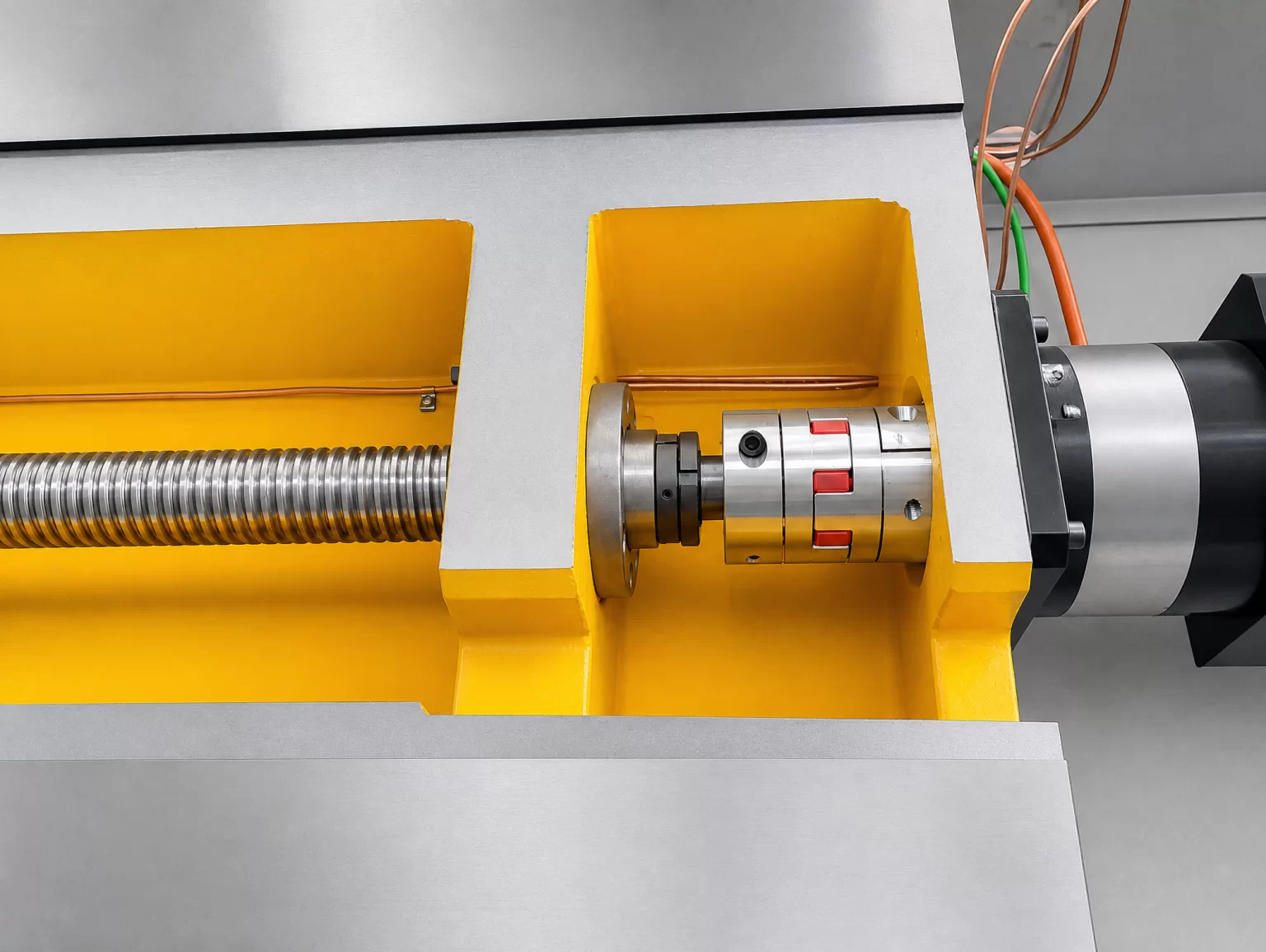
Confirming the screw is the cause
Backlash at the slide has four possible sources, and only one of them is the screw. Work through them in order, because replacing a ball screw that was not the problem is an expensive way to leave the fault in place.
First, establish the size and the character of the lost motion. Take the backlash reading in the middle of the travel and at both ends. If it is similar everywhere, the cause is play somewhere in the chain; if it is much worse at the ends of travel, alignment or localised wear is the more likely explanation. Second, check the support bearings by mounting an indicator on the screw end and loading the axis axially — end float there produces the same symptom as a worn nut. Third, confirm that lubrication is actually reaching the nut: a metering unit that has blocked delivers nothing, and the screw will fail again after replacement if the cause has not been found. Fourth, before condemning anything mechanical, rule out the electrical side: a slipping coupling, an encoder problem or a parameter that has been altered all produce position errors that look like backlash but are not.
Only when the backlash is confirmed as internal play in the screw and nut, and the lubrication and support bearings have been checked, is ball screw replacement the right answer. The remaining evidence worth having is a photograph of the raceway where the nut sits at the most-used position: scoring, pitting or discolouration there confirms both the diagnosis and, later, whether the new screw is being properly lubricated.
It is also worth checking whether the symptom has already been reported by the control. A growing position deviation will usually produce an alarm before it produces scrap, and comparing the alarm history with the backlash readings tells you how long the fault has been developing. The families of message to look for are covered in how CNC alarm codes are read.
What a correct replacement involves
Replacement is not a like-for-like part swap unless the machine is treated as one. Six elements belong together in the job, and leaving any of them out is what produces a machine that is no better after the new screw is fitted.
The screw and the nut are matched as a set: preload is established between a specific nut and a specific screw, and mixing a nut from one set with a screw from another loses the preload that gives the axis its rigidity. The support bearings at both ends are renewed with the screw, because a bearing that has been running with a failing screw has taken the same loads. The coupling or the belt is inspected and replaced if it has taken any abuse. Wipers and seals are renewed as a matter of course, since they are the reason the old screw failed.
Alignment is the step most often rushed. The screw has to be parallel to the guideway and coaxial with the support bearings to the tolerance stated in the machine documentation, and it is measured rather than judged: a dial indicator on the screw, readings taken along the travel, and adjustment of the bearing housings. Then the axis is re-referenced. On a machine with absolute encoders this is a defined procedure from the manual, and doing it carelessly leaves the control believing the axis is somewhere it is not — a mistake that ends in a collision rather than an error message.
Finally, the axis is run in and measured. Take the backlash reading at the same points as before the change, confirm it against the specification, and prove the result with a test cut rather than with the indicator alone. The first parts after a replacement are the ones worth measuring properly, because a screw that has been assembled with an alignment error shows up in them within a few hours of production.
What to send when ordering
A ball screw is not a generic part. Length, diameter, lead, accuracy grade, preload and end machining are all specific to the machine and the axis, and a screw that is almost right will not fit or will not hold tolerance. The order should carry the identification data rather than a description.
Send the machine model and machine number, the axis concerned, and the part number from the machine’s parts list or manual if it is available. Where the part number cannot be read, the measurements that identify the screw are the overall length, the diameter, the lead, the end journal dimensions and the mounting arrangement, together with photographs of both ends and of the nut. State whether the screw is for a standard or a custom machine, because the second case usually means the drawing has to be retrieved. The DF series pages show how the axis arrangement differs across the range, which is a useful cross-check that the model has been identified correctly.
It is also worth ordering the consumables with the screw rather than separately: wipers, seals and support bearings. They are a small part of the invoice and they are the items that decide whether the replacement lasts. If the machine is being maintained on a planned basis, the same logic is what the stock list should reflect, and the categories worth holding are set out in the maintenance checklist.
Before deciding to replace
- Backlash measured at the middle and at both ends of travel, without cutting metal
- Support bearings checked for end float and noise before the screw is condemned
- Lubrication confirmed as reaching the nut, with the metering units inspected
- Servo, encoder and coupling causes eliminated before anything is ordered
Recording the changeover
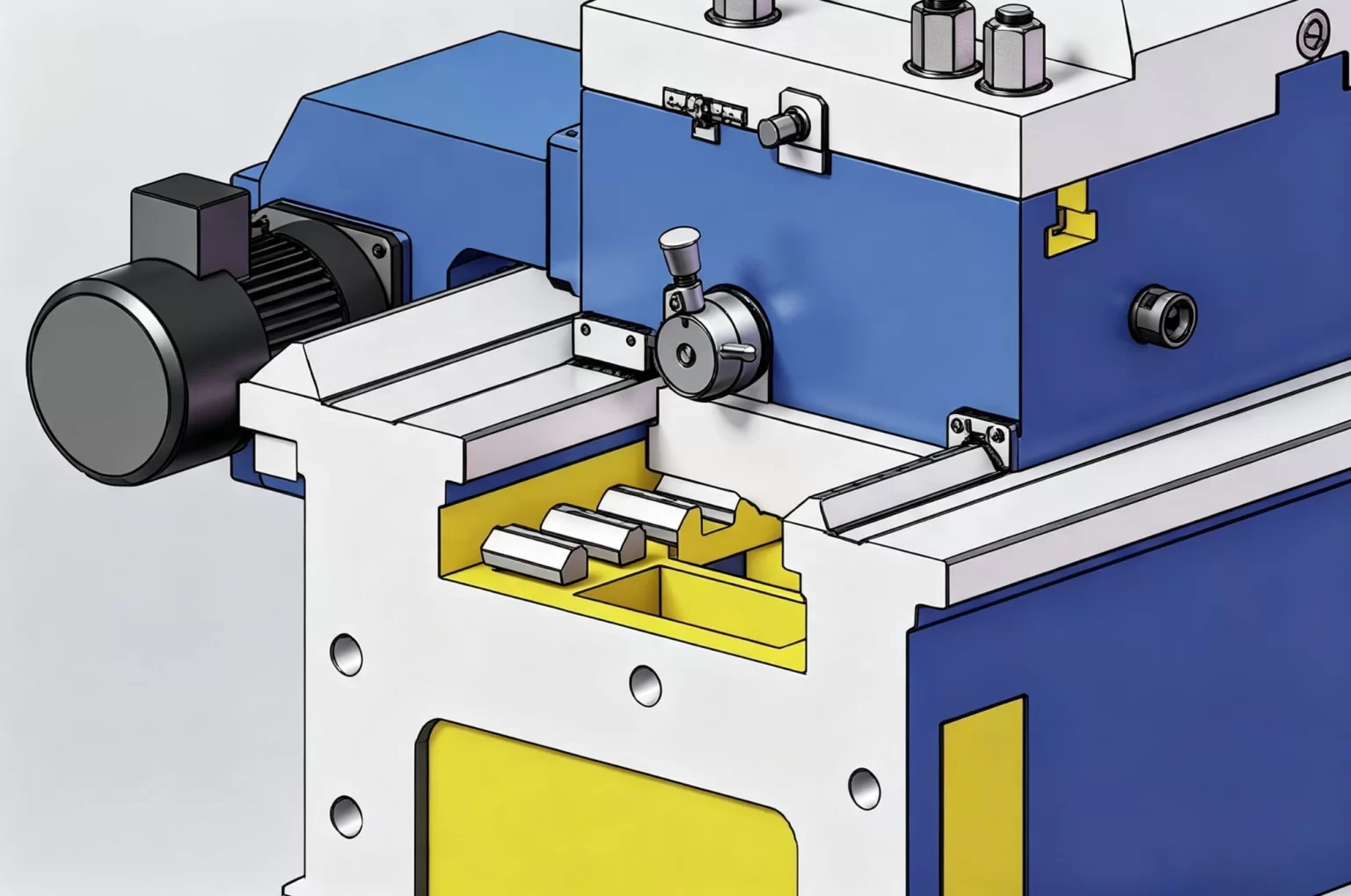
The record produced by a ball screw replacement is what makes the next one cheaper, and what allows a warranty question to be answered with evidence rather than opinion.
| Identification | Machine model and number, axis, and the part numbers of the screw, nut, support bearings, coupling, wipers and seals fitted |
|---|---|
| Condition found | Backlash readings at the middle and both ends of travel before the work, plus photographs of the raceway and the metering units |
| Cause identified | Which of the six causes was established, and what was done about it — a screw replaced without a cause is a screw that will fail again |
| Alignment readings | Parallelism to the guideway and concentricity at the bearing housings, with the tolerance they were compared against |
| Lubrication | The lubricant used, the quantity delivered at the nut, and the consumption measured after restarting production |
| Re-referencing | The reference procedure followed for the axis and the date, including any parameter modified |
| Proof | Backlash readings after the work at the same points as before, and the test cut result with its measuring positions |
| Hours | The machine hours at replacement, so that the service life of the new screw can be compared with the old one |
What to avoid
Do
- Measure the backlash before deciding anything, and record the numbers
- Check the lubrication delivery and the support bearings as part of the diagnosis
- Replace the screw and nut as a matched set, with the support bearings
- Re-align, re-reference and prove the result with a test cut before releasing production
Do not
- Order a part by description or by length alone — lead, grade and preload all matter
- Swap the nut onto a different screw to save time, which discards the preload
- Reset an absolute encoder reference without following the manual procedure
- Release the machine on the strength of a dial indicator push, without a test cut
One point deserves emphasis because it decides how long the repair lasts. A ball screw is a wear item, and it is designed to be lubricated for its whole life. When one fails early, the failure is nearly always a lubrication or contamination problem that will damage the replacement in exactly the same way. Finding the cause is therefore not an additional step in ball screw replacement; it is the part of the job that determines whether the next replacement is in ten years or in eighteen months.
Frequently asked questions
How do I know whether the screw or the guideway is worn?
By where the error appears. A worn ball screw shows as lost motion between the commanded and the actual position, measured with a dial indicator against the slide without cutting: the axis moves, the control reports arrival, and the indicator shows a difference. A worn guideway shows as a change in straightness and in the geometry of the part — a taper or a step that varies along the length of the cut. Both can be present, which is why the backlash measurement is taken at the middle and at both ends of travel before anything is ordered.
Can a ball screw be reconditioned instead of replaced?
In some cases the nut can be re-preloaded or reground, but the economics rarely work for a machine in production. The screw has to be removed, inspected and refinished, and the accuracy grade it returns with is not the grade it left the factory with. For a machine that holds tolerance on real work, replacement with a matched screw and nut is the predictable option, and it is usually faster than reconditioning because the part is either in stock or being manufactured rather than being assessed.
Does ball screw replacement need the axis to be re-referenced?
Yes. Removing the screw breaks the relationship between the mechanical position of the axis and the coordinate system the control holds, even when the new screw has the same nominal dimensions. On machines with absolute encoders this means following the manufacturer’s reference procedure exactly; on incremental systems it means the normal reference return after reassembly. Resetting an absolute encoder without the procedure leaves the control with a false idea of where the axis is, which is how a replacement ends in a collision.
What are the accuracy grade and preload, and why do they matter?
Both are part of what makes a screw a precision component rather than a threaded bar. The accuracy grade describes how far the actual travel deviates from the theoretical over a given length, expressed against a published standard; the preload is the internal interference between the balls and the raceways that removes axial play and gives the axis its rigidity. A replacement with a lower grade or without preload will fit and will run, and it will not hold the tolerance the machine was bought for. The published technical data from the screw and bearing manufacturers, such as the ball and roller screw information from SKF, is a reasonable reference for how those classifications work.
How long should a ball screw last?
Long enough that the machine wears out first, if it stays lubricated and clean. Life is set by the load it carries, the lubrication it receives and the contamination it is exposed to, not by a fixed calendar figure. The practical answer for a maintenance department is to trend both lubrication consumption and backlash: a screw that is receiving correct oil and whose backlash is still within specification after several years is behaving normally, and one whose backlash has moved in a matter of months is telling you that the cause has not been found.
Next step
Send the identification, not just the symptom. Send the machine model and number, the axis, the measured backlash before the work and the part number from the parts list if you can read it, and we will confirm the screw, nut and support bearing set that applies to your machine — together with the alignment tolerance, the lubrication specification and the reference procedure for the axis. The machine-side arrangement is shown on the DF series pages and the wider axis layout on the lathe series pages.
Ask about a ball screw replacement
WhatsApp: +86 15502628547 · Email: info@dhlathe.com
Photographs of both screw ends and of the raceway where the nut runs are the most useful attachments. Add the backlash readings taken before the work.
