
Operation & Maintenance
A cnc machine spare parts list is built from three numbers per item, not from a catalogue: how often the item fails, how long it takes to arrive, and what a day of stopped production costs while you wait. Items that fail, arrive slowly and stop the machine belong on the shelf. Items that fail rarely but arrive slowly are worth a shared pool between identical machines. Consumables follow the maintenance schedule. Everything else is a purchase decision, not a stock decision — and getting that classification right is most of the work.
Why the list is built from three numbers
Spare parts decisions are usually made by intuition, and intuition is poor at the arithmetic that actually matters. The number that matters is not the price of the part but the cost of not having it: a bearing that costs very little but has to travel a long way holds a machine for the whole of that journey, and the production time lost dwarfs the purchase price several times over.
A cnc machine spare parts list built from those three numbers is short, and every item on it is justified. The first number is failure probability — how often this item fails in service, on this type of machine, under this duty. The second is replenishment lead time, which for a bought-in component is the time from placing the order to having it in your hands, not the time to quote it. The third is downtime cost, expressed however your business measures it: hours of production lost, contract penalties, or the cost of an expedited shipment as a fallback.
Multiplying those three is what the classification rests on. An item that fails rarely, arrives quickly and only costs you a shift is a purchase the day it fails. An item that fails often, arrives slowly and stops a line is the one that justifies a shelf position and a written minimum level. A wear part on a single machine with no substitute is the strongest case of all, because there is no alternative route to production while you wait.
The question that sorts any part
“If this fails tomorrow, what do we do while we wait?” If the answer is “wait”, the part belongs on site. If the answer is “run the other machine”, the stock decision changes. If the answer is “we would fit whatever the local supplier has”, the real risk is not the part but the fact that nobody has defined which part is acceptable.
The five categories of part
Parts behave differently by category, and the categories need different stocking rules. Treating them all as “spares” is why stock rooms fill up with the wrong items.
| Category | Examples | Stocking rule |
|---|---|---|
| Wear parts | Guideway wipers, seals, belts, chuck jaws, way-cover elements, hydraulic filters, spindle bearings | Hold on site, sized from the measured replacement interval, with the wipers and seals scaled to the number of machines |
| Consumables | Way lubrication oil, hydraulic oil, coolant, grease, filters | Follow the maintenance schedule; hold one full change plus a margin |
| Electronics and drives | Servo drives, spindle drive, I/O modules, power supplies, control fans, batteries | Decide by machine count and lead time. One spare shared between several identical machines is usually the right answer; the backup battery is a stock item for every machine |
| Safety components | Door interlocks, emergency stop elements, guard switches, light curtains | Hold one of each type. These are the items that cannot be improvised and cannot be bypassed |
| Tooling and workholding spares | Tool holders, turret parts, chuck clamping elements, steady rest rollers, tailstock centres | Hold what wears and what stops the process; specials belong on the list earliest because they cannot be bought locally |
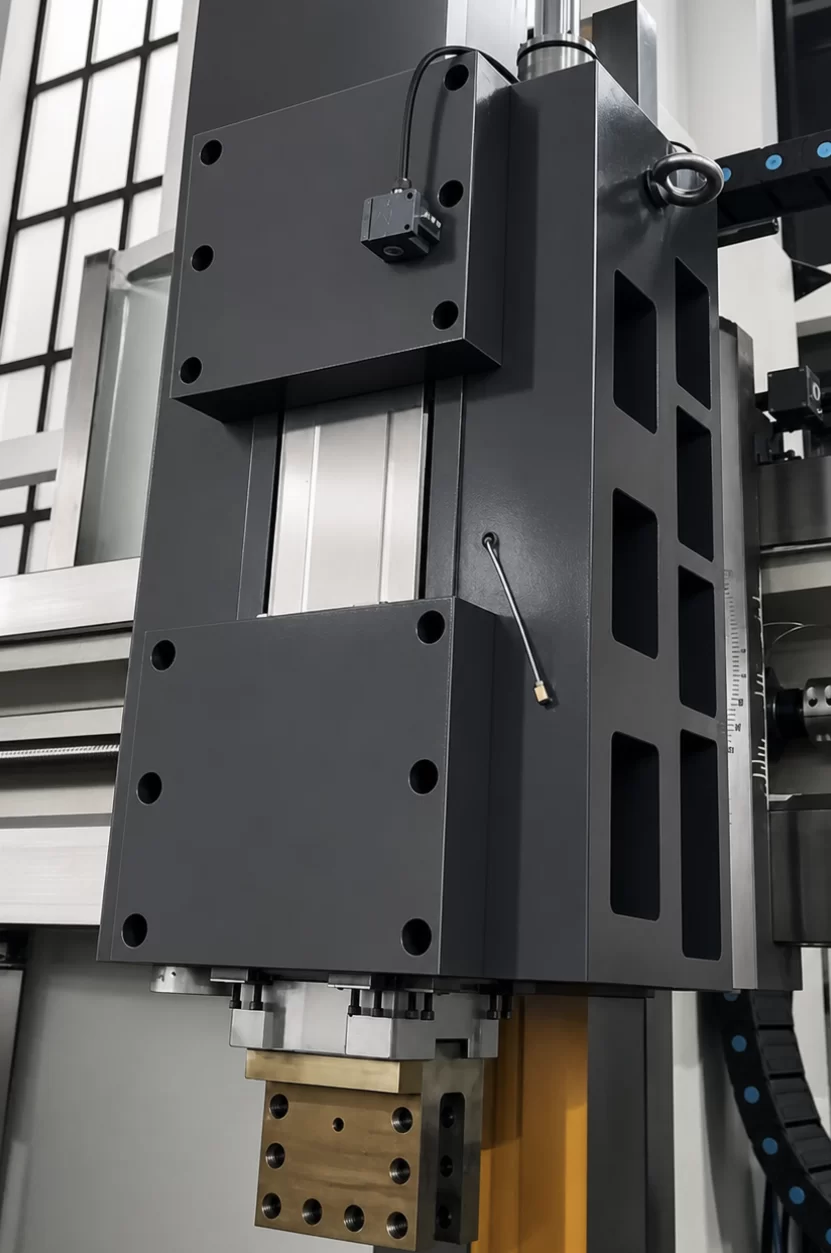
Sorting the list by criticality
Once every candidate part on the cnc machine spare parts list has a failure frequency, a lead time and a downtime consequence, the list sorts itself into four groups and each group has one correct answer.
Hold on site. Fails reasonably often, arrives slowly, stops production. These are the parts where the shelf position pays for itself, and they are usually the cheap ones: wipers, seals, belts, filters, chuck jaws, the backup battery. Hold as a pool. Fails rarely but has a long lead time and a high consequence: servo drives, spindle drive, control modules. One spare kept for a group of identical machines is a shared insurance policy, and the calculation is the same whether the machines are in one workshop or in one region. Buy on failure. Short lead time and low consequence — most standard fasteners, sensors and standard tooling. Keeping them on the shelf ties up money in items that can be collected tomorrow. Review. Everything else, meaning the parts nobody has yet classified: put them on a list with a review date rather than on a shelf.
The traps are at the edges of those groups. A part that has never failed is not automatically a buy-on-failure item: it may simply be a part on a machine that has not yet run long enough. And a part that is cheap to buy is not automatically worth stocking, because the storage cost and the risk of holding an obsolete item are real. The classification is worth revisiting once a year against actual failure history, which is one of the reasons the maintenance record matters as much as the stock list.
How much to hold
The quantity question has a simple structure. A minimum level is what you must never go below — in practice one item, or one per machine for items that fail predictably. A reorder point is the level at which an order is placed: the consumption during the replenishment lead time, plus the minimum. A maximum is what the shelf will hold without tying up more capital than the risk justifies. Writing those three numbers down for each item converts stock management from a feeling into a routine.
Two factors move the numbers. The first is the number of identical machines: with three machines of the same model, a single spare covers all three, and the failure probability that matters is the probability that any of them fails while the part is on order. The second is the measured replacement interval. A wiper that lasts months should be held in multiples; a seal expected to last years needs one, and needs a date on it. Holding more than the arithmetic justifies is the common error, and it is expensive twice: once in capital and once when the shelf is found to contain items that have aged out.
Where the machine is the only route to a contract, the arithmetic is different and worth stating plainly rather than debating. For a single machine with no substitute and a customer waiting, the cost of a stopped day is usually far larger than the price of the parts that could stop it. That is an argument for holding the complete wear parts set and the critical electronics, and it is worth quantifying rather than assuming, because it decides the budget.
What to agree about supply
A cnc machine spare parts list is only useful if the parts can be identified and obtained years later. Three things are worth agreeing while the machine is still new, when there is still leverage to agree them.
The first is part numbering: how long the numbers on the recommended list remain valid, and what happens when a component is superseded. The second is lead time, quoted for the common wear items rather than for the machine as a whole. The third is the identification data itself — the part numbers and brands of the control, drives, spindle bearings, ball screws and hydraulic components actually fitted to your machine. Without that data, every future enquiry starts with a photograph and a guess, and a machine built to a repeat order may not contain the same components as the original.
The general expectation that equipment is maintained in a safe and workable condition, set out in the guidance on the maintenance of work equipment, is the reason the parts position belongs in the maintenance plan rather than in a drawer: an unavailable part is an unavailable repair, and the machine stays out of service for reasons that were entirely foreseeable.
For single-source items, ask for a written statement of how long supply is committed and what the alternative is if the item is discontinued. That answer, given at order stage, is worth more than any discount on the machine, because it determines whether year eight of ownership is a maintenance exercise or a re-engineering project.
Storing parts without spoiling them
A spare part that has degraded on the shelf is worse than no part, because it is believed to be serviceable. Storage rules for a cnc machine spare parts list are short and specific.
- Rubber items — seals, O-rings, belts, hoses — age: keep them away from sunlight and heat, and record the date received so the oldest is used first
- Electronics: control the humidity, keep drives and modules in their antistatic packaging, and handle them with the power isolated
- Lubricants and coolants: store upright, sealed, within the temperature range on the container, and observe the shelf life for anything containing additives
- Bearings and precision parts: keep them in the original packaging until fitting, protected from condensation, and never store them loose on a shelf
- Label every item with the machine model it fits, the part number and the date received — an unlabelled part becomes an unknown part
- Keep the reserve physically separate from the day-to-day consumables, so that a critical part is not consumed because it was the nearest one
The parts register
| Identification | Part number, description, the machine models it fits, and the component brand where the part is bought in |
|---|---|
| Classification | Which of the four criticality groups it belongs to, and the reason — so the decision can be revisited rather than re-argued |
| Levels | Minimum, reorder point and maximum, with the lead time they were calculated from |
| Supply | Where it is obtained, the quoted lead time, the minimum order value, and whether it is single-sourced |
| History | When the item was last fitted and on which machine, and how long it lasted — the evidence that refines the next stock level |
| Storage requirement | Any shelf life, temperature or handling condition, so that whoever receives it stores it correctly |
| Date received | For first-in first-out control on anything that ages |
| Review date | For items in the “review” group, so that an unclassified part does not stay unclassified indefinitely |
The register is what turns a shelf into a plan. It also feeds the maintenance schedule: the same items appear as tasks in the maintenance checklist, and the failures that justify a stock level usually appear first as alarms, discussed in how alarm codes are read. Where a part is a known wear item with a measurable symptom before failure — a ball screw, for instance — the case for stocking it is made by the measurement rather than by the calendar, as set out in the diagnosis and replacement procedure for ball screws.
Frequently asked questions
How many spare parts should a workshop hold for one CNC machine?
Enough to cover the wear items and the one or two failures that stop the machine without warning. In practice that means the complete wiper, seal and belt set for the machine, filters for every circuit, a backup battery, at least one safety interlock element of each type, and the consumables for one full maintenance cycle. Electronics are the expensive decision: for a single machine the arithmetic usually justifies one critical drive shared with nothing, while for several identical machines one spare shared between them is the better trade.
Are aftermarket parts acceptable for a machine tool?
It depends on the part rather than on a general principle. Standard items — fasteners, hoses, filters, some bearings, seals specified by dimension — can often be sourced locally with no loss, provided the specification is matched and the supplier is credible. Parts that carry the machine’s accuracy or its safety are a different question: a ball screw, a spindle bearing set, a drive or an interlock is specified as a system, and substituting an equivalent-looking item can change the machine’s behaviour in ways that are hard to attribute later. The rule worth applying is whether the part’s specification can be verified by measurement and documentation.
What is the most commonly forgotten spare?
Wipers and seals. They are inexpensive, they are the parts that protect everything else, and because they do not stop the machine when they fail they are rarely on the shelf. A worn wiper lets fine swarf onto a guideway, which then damages the surfaces that the machine’s accuracy depends on. The second most commonly forgotten item is the backup battery for the control memory, which costs very little and protects the parameters and offsets that make the machine behave as it should.
How do I find the part numbers for my machine?
From the documentation supplied with the machine: the parts list or spare parts catalogue, the component list identifying the control, drives and bearing brands, and the lubrication chart. Where a part number is not available, the identification data on the component itself — the nameplate of a drive, the designation on a bearing, the dimensions of a seal — is usually enough to specify the replacement precisely. Photographing the nameplate of every major component when the machine is new is the least expensive way to make that information available five years later.
Do identical machines share the same spare parts list?
Not always, and assuming they do is a common source of wrong parts. Machines built to the same model number at different times can contain different control series, drives, bearing brands or hydraulic components, because suppliers change. Build one register per machine, record the components actually fitted, and mark which items are common across the fleet and which are specific. That distinction is what allows a shared pool to work without the pool containing a part that fits only one machine.
Next step
Ask for the cnc machine spare parts list that matches your machine, not the model. Send the machine model and number, the control and drive details from the nameplates, and the shift pattern the machine works, and we will return a recommended spare parts list organised by the four criticality groups — with part numbers, quoted lead times and the items worth holding on site from the first day. The manufacturing and testing steps behind the components are documented at how DAHUI MT builds and tests its machines.
Request the recommended spare parts list
WhatsApp: +86 15502628547 · Email: info@dhlathe.com
Photographs of the control and drive nameplates are the most useful attachments. They allow the list to be built against the components your machine actually has.
